Still growing.New universities and courses are added most weekdays (not weekends), each checked against the university's own page before it goes live — worth checking back. Sources last read 13 Sept 2026. How we verify →

StudyPath
QS #54Taipei, Taiwan· QS World University Rankings 2027

National Taiwan University (NTU)

National Taiwan University (NTU), in Taipei, Taiwan, has 4 undergraduate courses listed on StudyPath. International tuition runs from ~NT$100,920 to ~NT$120,000 a year depending on the course. NTU Taiwan publishes its own accommodation prices, from NT$7,900 per semester. 3 of the 4 publish an application deadline. 1 named scholarship is recorded against these courses. Every figure above was read from NTU Taiwan's own published pages and last checked on 25 August 2026.

Courses
4
Fees verified
4 / 4
Scholarship entries
3
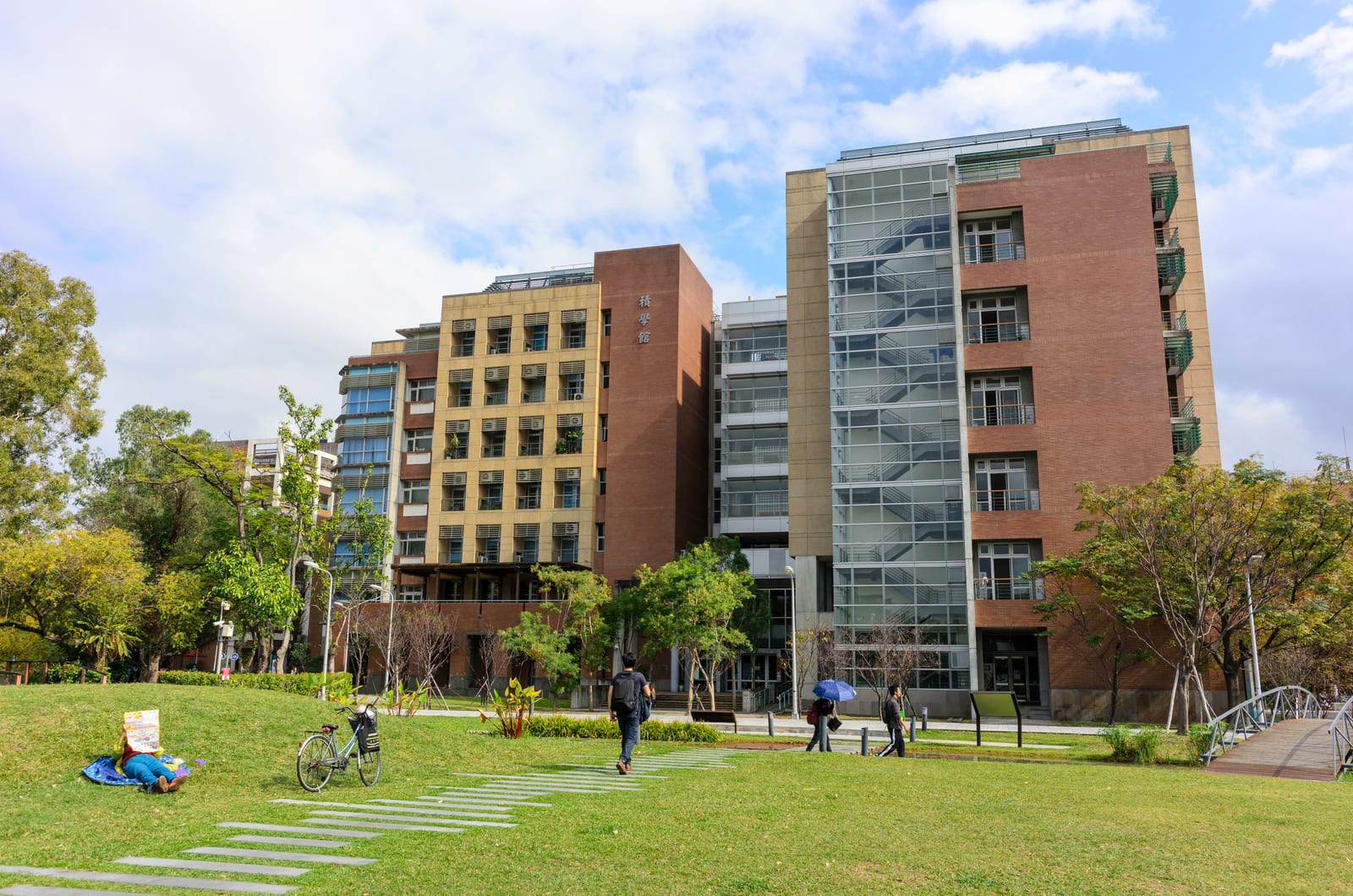
Department of Chemistry building and Ji-Xue Hall, National Taiwan University Verified
Department of Chemistry building and Ji-Xue Hall, National Taiwan University · Photo: 玄史生CC0
Applies everywhere on the site, on this device — change it any time.
Not set — every fee below is the international rate. Home and EU/EEA rates are often far lower.

courses

3 of 4

Bachelor's degree · Engineering (General)

International tuition

NT$58,940 per term

Verified

2026/27 · Faculty-wide rate · International students

This course starts in 2027, but NTU Taiwan has only published fees up to 2026/27. Expect the 2027 figure to be higher.

NTU prices undergraduate tuition by college, not by programme: this is the College of Engineering / Electrical Engineering & Computer Science column rate, which is what an IET student pays, not an IET-specific figure. Charged per semester; two semesters make an academic year (NTD 117,880). The schedule was passed at NTU's 3,216th Administration Meeting on 26 May 2026 and the total shown is Tuition (NTD 35,980) plus Fees (NTD 22,960). It matches the same college rate on NTU Admissions' international-student fee table, which carries no academic year of its own and is captioned 'for reference only'. Credit fees of NTD 2,300 apply to students in extension of study taking 9.5 credits or fewer.

Show the fee on the university's site

IET's own site does not publish a tuition figure, and NTU does not price this programme separately: tuition is set by college, so an IET student pays the College of Engineering / Electrical Engineering & Computer Science rate. NTU Admissions' international-student fee table shows that rate as NTD 58,940 per semester but carries no academic year and is captioned 'for reference only'; the dated figure recorded above comes from NTU's own 2026/27 tuition-and-fee schedule, which lists the identical total. Beyond tuition, NTU charges credit fees of NTD 2,300 to students in an extension of study taking 9.5 credits or fewer.

Show the source
Intake
September 2027 (2027 September Entry)
Source
Taught in
English. IET's official Application requirements page states plainly under 'Language of instruction': 'English-taught program'. Its Overview page separately describes it as 'an all-English interdisciplinary bachelor's degree program' aimed at international students.
Source
Application deadline
IET's own site has no department-specific deadline and directs applicants to NTU's general international-student process. For the 2027 September Entry cycle: 1st Round online application runs September 29 (11am) to November 5, 2026; 2nd Round runs December 1 (11am), 2026 to January 19, 2027.
Source

What you'll study

Not yet added.

Scholarships1 available
  • NTU Scholarship for International Degree Student

    Tuition waiver of up to NTD 65,000 (exclusive of administrative fees, thesis advisor's fees, insurance, accommodation, internet service, credit fees and other such fees) plus a monthly stipend of NTD 8,000, awarded for one year and renewable by reapplication each following academic year.

    Eligibility: Open to currently-enrolled international undergraduate students at National Taiwan University (this is NTU's own scholarship, separate from the government-administered Taiwan Government/MOE Scholarship listed on the same page). Students become eligible to apply once matriculated, via NTU's International Degree Current Students System, in the annual April-May application window; no separate GPA or grade threshold is published for this specific award. Does not include dual-degree students.

    NTU also administers several Taiwan Government Scholarships (MOE, MOFA, Taiwan Elite, Taiwan-Europe Semiconductor) for enrolled international students on the same source page, each with its own GPA renewal standard and stipend, and separate graduate-only NTU awards (International Outstanding Graduate Student Scholarship, Loyalty Award, Centennial Fellowship).

    Source
Entry requirementsEnglish · tests · grades · interview

English language

  • IELTS, 5.5 overallFrom IET's official Application requirements page, under 'Minimum language proficiency requirements'.
  • TOEFL iBT, 71 overallListed on the page as 'TOEFL (iBT) 71 or above'.
  • TOEIC, 750 overall
  • GEPT, High-Intermediate or aboveGeneral English Proficiency Test (Taiwan's national English test); 'High-Intermediate or above' required.
Source

Admissions tests

None required for this course, per the university.
Source

Academic offer

General NTU-wide standard for all international undergraduate applicants (IET's own page states no department-specific academic threshold beyond submitting a graduation certificate and transcript): at least a high school diploma or equivalent.
Source
Convert your grade to compare →

Interview

Not required. IET's own Application requirements page lists 'Interview / Oral exam' as None and 'Written exam' as None.
Source

Bachelor's degree · 4 years · Electrical & Electronic Engineering, Materials Science

International tuition

NT$60,000 per term

~NT$480,000 for the whole 4 years, at today's fee
Verified

2026/27 · Priced for this course · International students

This course starts in 2027, but NTU Taiwan has only published fees up to 2026/27. Expect the 2027 figure to be higher.

GUPS has its own column in NTU's fee schedule, so this rate is specific to the programme rather than a college-wide one. Charged per semester; two semesters make an academic year (NTD 120,000), which matches the 'Fee (per year): International: 120,000 NTD' figure GUPS states on its own admissions page and the NTD 60,000-per-semester entry on NTU Admissions' fee table - neither of which carries an academic year. The schedule was passed at NTU's 3,216th Administration Meeting on 26 May 2026; the total is Tuition (NTD 36,000) plus Fees (NTD 24,000). Overseas Chinese and Hong Kong & Macao students pay half this rate.

Show the fee on the university's site

GUPS states 'Fee (per year): International: 120,000 NTD' in the at-a-glance summary on its own admissions page, with Overseas Chinese and Hong Kong & Macao students paying NTD 60,000 per year. That page attaches no academic year to the figure, but it matches exactly the NTD 60,000 per semester (NTD 120,000 per year) that NTU's dated 2026/27 tuition-and-fee schedule lists for the International College GUPS column, which is the figure recorded above.

Show the source
Intake
September 2027 (2027 September Entry)
Source
Taught in
English. GUPS's own overview page states: 'Global Undergraduate Program in Semiconductors (GUPS) is a full English undergraduate program with a specialized focus on semiconductor technology.' Its curriculum page separately requires students to pass a Chinese Proficiency Test (CEFR B1 / TOCFL Level 3) before graduation — a graduation requirement, not the medium of instruction — and notes that beyond the required English curriculum, students 'may enroll in courses from other disciplines within the university that are taught in English or Chinese' for general-elective credit.
Source
Application deadline
For GUPS's 2027 September Entry cycle, international-student applications run in two rounds: 1st Round opens September 29, 2026 and closes November 5, 2026; 2nd Round opens December 1, 2026 and closes January 9, 2027 (per GUPS's own admissions page). Note: NTU's general international-student timeline separately states January 19, 2027 as the general 2nd-round close date, ten days later than GUPS's own page states; GUPS's own program-specific page is used here as the more specific source.
Source

What you'll study

Not yet added.

Scholarships1 available
  • NTU Scholarship for International Degree Student

    Tuition waiver of up to NTD 65,000 (exclusive of administrative fees, thesis advisor's fees, insurance, accommodation, internet service, credit fees and other such fees) plus a monthly stipend of NTD 8,000, awarded for one year and renewable by reapplication each following academic year.

    Eligibility: Open to currently-enrolled international undergraduate students at National Taiwan University (this is NTU's own scholarship, separate from the government-administered Taiwan Government/MOE Scholarship listed on the same page). Students become eligible to apply once matriculated, via NTU's International Degree Current Students System, in the annual April-May application window; no separate GPA or grade threshold is published for this specific award. Does not include dual-degree students.

    NTU also administers several Taiwan Government Scholarships (MOE, MOFA, Taiwan Elite, Taiwan-Europe Semiconductor) for enrolled international students on the same source page, each with its own GPA renewal standard and stipend, and separate graduate-only NTU awards (International Outstanding Graduate Student Scholarship, Loyalty Award, Centennial Fellowship).

    Source
Entry requirementsEnglish · grades

English language

  • TOEFL, B2 levelGUPS accepts an 'English language certificate' at CEFR B2 level from any of six named tests (TOEFL, IELTS, TOEIC, GEPT, Cambridge Main Suite, BULATS); no separate numeric cutoff per test is published on this page. Waived for applicants from English-speaking countries or with a previous degree taught entirely in English.
  • IELTS, B2 levelSee TOEFL entry for shared context: one of six accepted CEFR B2-level certificates.
  • TOEIC, B2 levelSee TOEFL entry for shared context: one of six accepted CEFR B2-level certificates.
  • GEPT, B2 levelGeneral English Proficiency Test. See TOEFL entry for shared context: one of six accepted CEFR B2-level certificates.
  • Cambridge Main Suite, B2 levelSee TOEFL entry for shared context: one of six accepted CEFR B2-level certificates.
  • BULATS, B2 levelSee TOEFL entry for shared context: one of six accepted CEFR B2-level certificates.
Source

Academic offer

General NTU-wide standard for all international undergraduate applicants: at least a high school diploma or equivalent. GUPS's own admissions page separately requires submission of a 'Graduation certificate of highest degree awarded' (a Provisional Graduation Certificate for current-year graduates) as a supporting document, but states no additional grade/GPA threshold.
Source
Convert your grade to compare →

Bachelor's degree · Economics

International tuition

NT$50,460 per term

Verified

2026/27 · Faculty-wide rate · International students

NTU prices undergraduate tuition by college, not by programme: Economics sits in the College of Social Sciences, whose column in NTU's tuition schedule is headed "Liberal Arts, Social Sciences, Law" and totals NTD 50,460 (Tuition 35,700 + Fees 14,760) per semester for international students enrolled from the 2011/12 academic year onward. Charged per semester; two semesters make an academic year (NTD 100,920). The schedule was passed at NTU's 3,216th Administration Meeting on 26 May 2026. Not an Economics-specific figure -- it is the same rate every Liberal Arts, Social Sciences or Law undergraduate at NTU pays.

Show the fee on the university's site
Intake
Not verified
Taught in
English
Source
Application deadline
Not verified

What you'll study

Not yet added.

Advertisement

More about NTU Taiwan

Student body

QS's own figures · QS World University Rankings 2027

Students
17,495
International students
4,462
≈26% of the student body (worked out here)
Faculty
2,194
International faculty
12%

These come from QS, not the university's own pages. Unlike every fee and deadline on this site. QS is the primary source for its own rankings and measurements, which is why it is cited here and rejected everywhere else.

Show the QS profile

About & contact

Taipei, Taiwan· view on Google Maps ↗ntu.edu.tw

Find nearby

These open a map search near Taipei. StudyPath isn't listing or vouching for specific places — what the university itself publishes about on-campus facilities appears under On-campus amenities, cited like everything else here.

No admissions email, phone number, or address verified for this university yet. Not yet collected, not necessarily unavailable.

Accommodation

NT$7,900–NT$13,460per semester

on-campus dormitory (undergraduate/graduate women's dorms), semester dormitory fee before subsidy, across dorm buildings. The subsidy is not open to international students: NTU states that since the second semester of 2023-2024 the Executive Yuan has subsidised on-campus dormitory fees for local students — NT$5,000 a semester for general students and NT$7,000 for students from middle-low and low-income families — and asks overseas Chinese and foreign students who hold ROC nationality to send their ID card to the Accommodation Office. A student without ROC nationality therefore pays the un-subsidised figure shown here, and the subsidy never applies to summer accommodation.

Published by the university itself, not a live listings price. Actual cost depends on room type, availability and when you apply.

Show the source

After you graduate

Rules read 19 Aug 2026

What Taiwan's own immigration authority currently publishes. Not a ranking, not a guarantee, and not the same as what any agent or forum will tell you. Whether someone actually obtains residence depends on occupation, points, funds and policy that can change between application and graduation.

Work during study

A foreign student may work part-time in Taiwan only after obtaining a separate work permit from the Workforce Development Agency (an agency of the Ministry of Labor); a student who has come to Taiwan purely for a local-language course may only apply for this permit after having studied for a year or more. With the exception of winter and summer vacations, a foreign student's total working hours may not exceed 20 hours a week — a limit the Agency's own page traces directly to Article 50 of the Employment Services Act.

Show the source

Post-study work visa

Work permit exemption during the extended residence of new graduates . Up to 2 years
A foreign national who obtains an associate degree or higher in Taiwan, and who receives approval from the National Immigration Agency (Ministry of the Interior) to extend their residence as a new graduate, may work in Taiwan during that extended-residence period without needing to apply for a work permit at all. They may take up full-time or part-time work, in any industry or position, for any employer, for up to 2 years. Work that requires a specific professional qualification or licence under other laws (e.g. medicine) still requires that separate qualification. Once this extended-residence period ends, a graduate who wants to keep working needs their employer to apply for an ordinary work permit — commonly via the Ministry of Labor's points-based scoring system for foreign and overseas Chinese student graduates, introduced 3 July 2014, which scores education, salary, work experience, Chinese and other language proficiency, background and other factors, with a permit granted to anyone scoring 70 or more of the available points.

Show the source

Route to citizenship

Taiwanese nationality by naturalisation is governed by the Nationality Act, administered by the Ministry of the Interior. The general route (Article 3) requires a foreign national or stateless person domiciled in Taiwan to have legally resided in the territory for more than 183 days a year for at least 5 consecutive years, have legal capacity under both R.O.C. and their own country's law, have no bad conduct or criminal record (certified by a Police Clearance Certificate), have enough property or professional skill to support themselves or maintain a stable livelihood, and possess basic Mandarin proficiency plus basic knowledge of the rights and duties of an R.O.C. national. Faster routes exist for a spouse of an R.O.C. national (3 years) and for a recommended 'high-level professional' whose contribution is jointly reviewed and approved (2 years' residence at 183+ days/year, or 5 years otherwise). On dual nationality, the Act states the default plainly: 'a foreign national applying for naturalization shall provide a certificate of loss of original nationality within one year' of naturalisation being approved (or, if their home country's law only allows renunciation at a later age, within one year of reaching that age) — and a foreign national may not even reside in Taiwan as a naturalised citizen before submitting that certificate. Failure to provide it in time means the naturalisation itself is revoked. A narrow exemption from this renunciation requirement exists only for naturalisation granted under a specific subparagraph of Article 5 and under Article 6 — the high-level-professional and special-contribution routes reported elsewhere as Taiwan's recognised dual-citizenship exception — or where the applicant genuinely cannot obtain a loss-of-nationality certificate for reasons outside their control. For the ordinary 5-year route most relevant to a graduate with no such distinguishing recommendation, renunciation of the original nationality is required, not optional.

Show the source

New entry added 19 August 2026. Two Taiwanese government domains added to IMMIGRATION_DOMAINS in scripts/verify.mjs: wda.gov.tw (Workforce Development Agency, Ministry of Labor — covering its ezworktaiwan.wda.gov.tw subdomain, the actual work-permit authority for foreign students and graduates) and ris.gov.tw (Department of Household Registration, Ministry of the Interior — the nationality/naturalisation authority, whose own site hosts the Nationality Act's official English translation). Collection note: the Nationality Act PDF returned raw binary bytes to this project's default fetcher; it was downloaded and converted with pdftotext (poppler-utils, -enc UTF-8 -layout) and archived via fetch-source.mjs --save, the pattern already used elsewhere in this dataset for PDF-only government sources. The PDF's own layout interleaves running header labels ('Article 4', 'Article 5', ...) into the flowing body text in a way that makes it genuinely hard to attribute every clause to a specific article/subparagraph number with full confidence from the extracted text alone — this entry states article numbers only where the mapping is clear (Article 3's five-year route, and the literal 'Article 5' / 'Article 6' cross-references inside the renunciation-exemption clause itself) and otherwise describes routes by their substance. residencyRoute is left null: this dataset found no distinct 'permanent residence' status published separately from the extended post-graduation residence (postStudyWork) and the ordinary work-permit system — a graduate's realistic path runs directly from work authorisation into the naturalisation years described under citizenshipRoute, rather than through a separate named PR status. inDemandOccupations is left null: Taiwan's points-based scoring system for student graduates (mentioned under postStudyWork) weighs general factors (education, salary, experience, language) rather than naming specific occupations, and the six general work categories for foreign professionals are broad fields, not a shortage list. naturalisationStatus set to 'published-route': the Nationality Act publishes real, numbered residence, character, language and financial criteria — per the doc comment on ResidencyPathway.naturalisationStatus this field records only whether criteria are published, not how demanding Taiwan's renunciation requirement is for the ordinary route. citizenshipTerms records the Article 3 general route: 5 consecutive years with more than 183 days of legal residence in each. dualCitizenshipAllowed is false for that route — the Nationality Act requires a certificate of loss of original nationality within one year of approval, and failure to provide it revokes the naturalisation. The exemption quoted in citizenshipRoute is confined to the Article 5(1)(iii) and Article 6 high-level-professional and special-contribution routes, or to cases where the certificate cannot be obtained for reasons outside the applicant’s control.

Open the immigration authority's own page ↗

Advertisement

Student photos

Contributed by students and applicants. Not checked the way the campus photos above are, just real photos from people who've actually been here.

Loading…

What students say about NTU Taiwan

Opinions from students and applicants. Not checked against the university's own pages the way the fees and deadlines above are.

to write a review. Signing in with your university email marks you as a verified student here.

Loading reviews…