Still growing.New universities and courses are added most weekdays (not weekends), each checked against the university's own page before it goes live — worth checking back. Sources last read 13 Sept 2026. How we verify →

StudyPath
QS #=111Rome, Italy· QS World University Rankings 2027

Sapienza University of Rome (Sapienza Università di Roma)

Sapienza University of Rome (Sapienza Università di Roma), in Rome, Italy, has 12 undergraduate courses listed on StudyPath. International tuition is €300 a year. Sapienza publishes its own accommodation prices, from €500 per month. All of them publish an application deadline. Every figure above was read from Sapienza's own published pages and last checked on 25 August 2026.

Courses
12
Fees verified
12 / 12
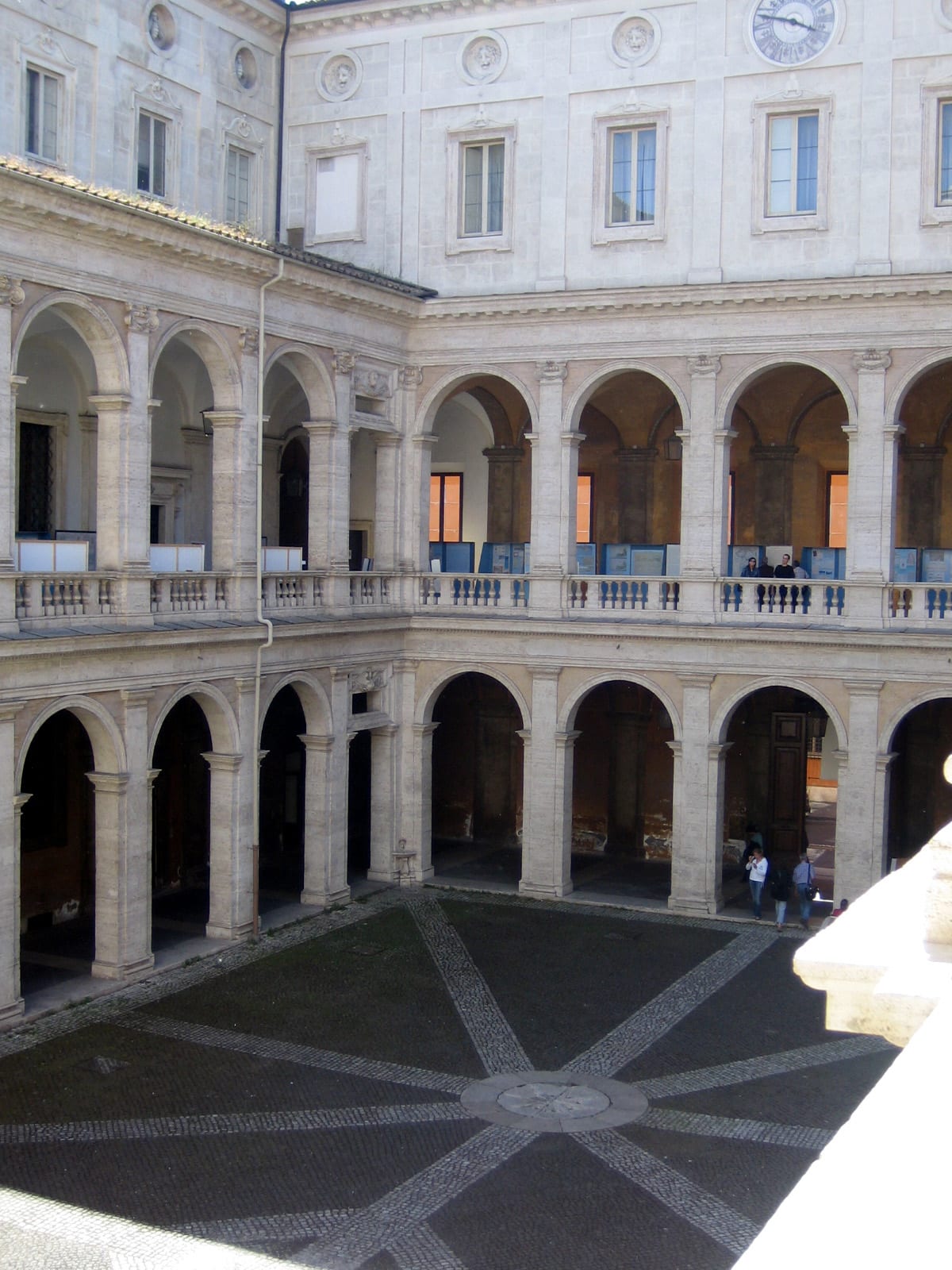
sapienza courtyard Verified
sapienza courtyard · Photo: Uploaded on May 19, 2005; by antmooseCC BY 2.0
Applies everywhere on the site, on this device — change it any time.
Not set — every fee below is the international rate. Home and EU/EEA rates are often far lower.

courses

6 of 12

Bachelor · 3 years · Computer Science, Data Science & AI

International tuition

€300 per year

~€900 for the whole 3 years, at today's fee
Verified

2026/2027 · Same rate across the institution · International students

Sapienza charges one flat annual contribution to students whose income is earned abroad (and who therefore cannot file an Italian ISEE), banded by country. The 300 EUR figure recorded here is Band A, the lowest of three bands and the one that covers most of the world's international student population — Sapienza's own Art. 38 fee schedule lists Band A as including, among many others, India, Pakistan, Bangladesh, Nigeria, Egypt, Indonesia, the Philippines, Vietnam, China, Brazil, Morocco, Kenya and South Africa. Band B (Turkey, Malaysia, Mexico, Poland, Romania, Kazakhstan, Lebanon, Iran and others) is EUR 700 a year and Band C (the high-income countries: UAE, Saudi Arabia, Qatar, Singapore, Hong Kong, Japan, Korea, Australia, Canada, the US, the UK and most of western Europe) is EUR 1,500 a year. See costContext for the full published band table. A student's band follows where their household income is declared, not their passport alone, so check the Art. 38 list rather than assuming. On top of the contribution, every enrolled student also pays a regional tax and stamp duty, and every applicant pays a non-refundable EUR 30 pre-selection application fee per application (maximum two applications per intake, no waivers). The contribution is a flat rate: Sapienza's regulations state that students paying it cannot then also claim ISEE-based reductions.

Show the fee on the university's site

Sapienza publishes the exact band amounts in Art. 38 of its Student Regulations, under the heading "Costs if you file income tax returns in foreign countries": Band A EUR 300 a year, Band B EUR 700, Band C EUR 1,500, each payable in three instalments. The same article states that if you earn income in foreign countries and therefore cannot submit the Italian ISEE declaration, you pay this fixed contribution instead, with the band determined by country "based on GDP (Gross Domestic Product) adjusted to PPP (Purchasing Power Parity)". Two things are charged on top and are not tuition: the regional tax (EUR 140) and stamp duty (EUR 16), both of which Art. 38 lists separately for other categories of student. Sapienza also warns on the same page that a non-EU applicant must separately demonstrate sufficient financial means to obtain a study visa and residence permit. Note the trade-off attached to the flat band rate: Art. 38 section 5 states that a student paying a flat-rate contribution cannot also pay on the basis of an ISEE, cannot claim a refund of enrolment fees if awarded a DiscoLazio regional scholarship, and cannot benefit from further fee reductions.

Show the source
Intake
Not verified
Taught in
English
Source
Application deadline
Sapienza runs a compulsory online "pre-selection" for its English-taught programmes, and the window for visa-requiring applicants closes far earlier than the general one. For 2026-2027 the pre-selection opened on 22 December 2025 and the non-EU (visa applicant) deadline was 15 May 2026, after which pre-accepted students had to register on the Italian government's Universitaly platform by 30 June 2026. EU and EU-equivalent candidates had until 31 July 2026. As of this record the 2026-2027 non-EU window has already closed; Sapienza's page states the deadline "expired on May 15, 2026" and that between 15 May and the end of June 2026 non-EU candidates could only apply for Italian-taught programmes. On this cycle's pattern, a non-EU applicant for the following year should expect the pre-selection to open around late December and close in mid-May. Each candidate may submit at most two applications per academic year, and each application costs a non-refundable EUR 30 with no waiver available.
Source

What you'll study

Not yet added.

Bioinformatics

Bachelor · 3 years · Bioinformatics, Biology & Life Sciences, Computer Science

International tuition

€300 per year

~€900 for the whole 3 years, at today's fee
Verified

2026/2027 · Same rate across the institution · International students

Band A of Sapienza's three-band flat contribution for students whose income is declared abroad. Band B is EUR 700 a year and Band C is EUR 1,500 a year; the full country lists are published in Art. 38 of the Student Regulations and reproduced in costContext. Regional tax, stamp duty and a EUR 30 per-application pre-selection fee are charged separately.

Show the fee on the university's site

Sapienza's Art. 38 fee schedule sets the flat annual contribution for students who file income tax returns abroad at EUR 300 (Band A), EUR 700 (Band B) or EUR 1,500 (Band C), each paid in three instalments. Bands are assigned by country "based on GDP (Gross Domestic Product) adjusted to PPP (Purchasing Power Parity)". The regional tax (EUR 140) and stamp duty (EUR 16) are charged on top and are not tuition. Art. 38 section 5 adds that a student on a flat-rate contribution cannot also pay by ISEE, cannot reclaim enrolment fees against a DiscoLazio regional scholarship, and cannot stack further fee reductions.

Show the source
Intake
Not verified
Taught in
English
Source
Application deadline
Compulsory online pre-selection. For 2026-2027 it opened on 22 December 2025 and closed for non-EU visa applicants on 15 May 2026, with successful candidates then required to register on Universitaly by 30 June 2026; EU and EU-equivalent candidates had until 31 July 2026. Maximum two applications per candidate per academic year, EUR 30 each, non-refundable, no waivers.
Source

What you'll study

Not yet added.

Bachelor · 3 years · Biochemistry, Pharmacology, Computer Science, Molecular Biology, Chemistry

International tuition

€300 per year

~€900 for the whole 3 years, at today's fee
Verified

2026/2027 · Same rate across the institution · International students

Band A of Sapienza's three-band flat contribution for students whose income is declared abroad. Band B is EUR 700 a year and Band C is EUR 1,500 a year; the full country lists are published in Art. 38 of the Student Regulations and reproduced in costContext. Regional tax, stamp duty and a EUR 30 per-application pre-selection fee are charged separately.

Show the fee on the university's site

Sapienza's Art. 38 fee schedule sets the flat annual contribution for students who file income tax returns abroad at EUR 300 (Band A), EUR 700 (Band B) or EUR 1,500 (Band C), each paid in three instalments. Bands are assigned by country "based on GDP (Gross Domestic Product) adjusted to PPP (Purchasing Power Parity)". The regional tax (EUR 140) and stamp duty (EUR 16) are charged on top and are not tuition. Art. 38 section 5 adds that a student on a flat-rate contribution cannot also pay by ISEE, cannot reclaim enrolment fees against a DiscoLazio regional scholarship, and cannot stack further fee reductions.

Show the source
Intake
Not verified
Taught in
English
Source
Application deadline
Compulsory online pre-selection. For 2026-2027 it opened on 22 December 2025 and closed for non-EU visa applicants on 15 May 2026, with successful candidates then required to register on Universitaly by 30 June 2026; EU and EU-equivalent candidates had until 31 July 2026. This programme additionally runs a separate NON-EU quota selection with its own published ranking list, so a non-EU applicant should read the programme's own announcements as well as the central pre-selection page.
Source

What you'll study

Not yet added.

Bachelor · 3 years · Earth & Environmental

International tuition

€300 per year

~€900 for the whole 3 years, at today's fee
Verified

2026/2027 · Same rate across the institution · International students

Band A of Sapienza's three-band flat contribution for students whose income is declared abroad. Band B is EUR 700 a year and Band C is EUR 1,500 a year; the full country lists are published in Art. 38 of the Student Regulations and reproduced in costContext. Regional tax, stamp duty and a EUR 30 per-application pre-selection fee are charged separately. This programme is taught at Sapienza's Rieti campus rather than in Rome.

Show the fee on the university's site

Sapienza's Art. 38 fee schedule sets the flat annual contribution for students who file income tax returns abroad at EUR 300 (Band A), EUR 700 (Band B) or EUR 1,500 (Band C), each paid in three instalments. Bands are assigned by country "based on GDP (Gross Domestic Product) adjusted to PPP (Purchasing Power Parity)". The regional tax (EUR 140) and stamp duty (EUR 16) are charged on top and are not tuition. Art. 38 section 5 adds that a student on a flat-rate contribution cannot also pay by ISEE, cannot reclaim enrolment fees against a DiscoLazio regional scholarship, and cannot stack further fee reductions.

Show the source
Intake
Not verified
Taught in
English
Source
Application deadline
Compulsory online pre-selection. For 2026-2027 it opened on 22 December 2025 and closed for non-EU visa applicants on 15 May 2026, with successful candidates then required to register on Universitaly by 30 June 2026; EU and EU-equivalent candidates had until 31 July 2026. Admission to this programme is by an entrance test to verify knowledge rather than a ranked admission test.
Source

What you'll study

Not yet added.

Single-cycle master's degree (Laurea Magistrale a Ciclo Unico) · 6 years · Medicine

International tuition

€300 per year

~€1,800 for the whole 6 years, at today's fee
Published, undated

Same rate across the institution · International students

Sapienza publishes this figure without stating which year it applies to, so it may already be out of date. Treat it as a starting point and check the course page for the current rate. Flag it below if you know it has changed.

Band A of Sapienza's three-band flat contribution for students whose income is declared abroad. Band B is EUR 700 a year and Band C is EUR 1,500 a year, assigned by country on GDP adjusted to PPP. A student who can instead file an Italian ISEE pays by contribution bracket, and this programme's faculty (Medicine and Dentistry) sits in the Second bracket at EUR 2,924. Regional tax (EUR 140), stamp duty (EUR 16) and a EUR 30 per-application pre-selection fee are charged separately.

Show the fee on the university's site

Sapienza charges international students who cannot file an Italian ISEE a flat annual contribution set by country band under Art. 38: EUR 300 (Band A), EUR 700 (Band B) or EUR 1,500 (Band C), each paid in three instalments, with bands assigned on GDP adjusted to PPP. Students who do file an ISEE pay by contribution bracket instead, and the Faculty of Medicine and Dentistry sits in the Second bracket at EUR 2,924 a year. The regional tax (EUR 140) and stamp duty (EUR 16) are charged on top and are not tuition.

Show the source
Intake
Not verified
Taught in
English
Source
Application deadline
Compulsory online pre-selection. For 2026-2027 it opened on 22 December 2025 and closed for non-EU visa applicants on 15 May 2026, with successful candidates then required to register on Universitaly by 30 June 2026; EU and EU-equivalent candidates had until 31 July 2026. This programme also requires the national admission test.
Source

What you'll study

Not yet added.

Entry requirementstests

Admissions tests

  • Admission test requiredA national admission test, sat once a year at Italian universities offering an English-taught medical programme (Rome, Milan, Pavia, Bari, etc.) and at several cities outside Italy.
Source

Single-cycle master's degree (Laurea Magistrale a Ciclo Unico) · 6 years · Dentistry

International tuition

€300 per year

~€1,800 for the whole 6 years, at today's fee
Published, undated

Same rate across the institution · International students

Sapienza publishes this figure without stating which year it applies to, so it may already be out of date. Treat it as a starting point and check the course page for the current rate. Flag it below if you know it has changed.

Band A of Sapienza's three-band flat contribution for students whose income is declared abroad. Band B is EUR 700 a year and Band C is EUR 1,500 a year, assigned by country on GDP adjusted to PPP. A student who can instead file an Italian ISEE pays by contribution bracket, and this programme's faculty (Medicine and Dentistry) sits in the Second bracket at EUR 2,924. Regional tax (EUR 140), stamp duty (EUR 16) and a EUR 30 per-application pre-selection fee are charged separately.

Show the fee on the university's site

Sapienza charges international students who cannot file an Italian ISEE a flat annual contribution set by country band under Art. 38: EUR 300 (Band A), EUR 700 (Band B) or EUR 1,500 (Band C), each paid in three instalments, with bands assigned on GDP adjusted to PPP. Students who do file an ISEE pay by contribution bracket instead, and the Faculty of Medicine and Dentistry sits in the Second bracket at EUR 2,924 a year. The regional tax (EUR 140) and stamp duty (EUR 16) are charged on top and are not tuition.

Show the source
Intake
Not verified
Taught in
English
Source
Application deadline
Compulsory online pre-selection. For 2026-2027 it opened on 22 December 2025 and closed for non-EU visa applicants on 15 May 2026, with successful candidates then required to register on Universitaly by 30 June 2026; EU and EU-equivalent candidates had until 31 July 2026. This programme also requires the national admission test.
Source

What you'll study

Not yet added.

Advertisement

More about Sapienza

Student body

QS's own figures · QS World University Rankings 2027

Students
63,178
International students
5,380
≈9% of the student body (worked out here)
Faculty
3,084
International faculty
3%

These come from QS, not the university's own pages. Unlike every fee and deadline on this site. QS is the primary source for its own rankings and measurements, which is why it is cited here and rejected everywhere else.

Show the QS profile

About & contact

Rome, Italy· view on Google Maps ↗uniroma1.it

Find nearby

These open a map search near Rome. StudyPath isn't listing or vouching for specific places — what the university itself publishes about on-campus facilities appears under On-campus amenities, cited like everything else here.

No admissions email, phone number, or address verified for this university yet. Not yet collected, not necessarily unavailable.

Accommodation

€500–€850per month

Monthly all-in price for a room in the housing Sapienza lists in its own register of affiliated facilities, by Rome neighbourhood. The price includes rent, condominium fees, utilities, heating, Wi-fi and the initial room cleaning. Studio apartments sit above this range.

  • Monti Tiburtini, Pietralata or Ponte Mammolo€500–€650
  • Pigneto, San Lorenzo or Malatesta€500–€650
  • Trastevere, Testaccio or Circo Massimo€560–€700
  • Aurelio, Baldo degli Ubaldi or Gregorio VII€600–€850
  • City Center€650–€800

The same register lists studio apartments in Garbatella at €1,050 to €1,200 a month, above the room range. Sapienza requires affiliated facilities to include all utilities, internet connection included, in the fee. Separately, the register lists the Elis residence at €8,500.00 per year for a single room bed and €7,200.00 per year for a quadruple room bed, with two scholarships discounting the annual fee.

Published by the university itself, not a live listings price. Actual cost depends on room type, availability and when you apply.

Show the source

After you graduate

Rules read 17 Aug 2026

What Italy's own immigration authority currently publishes. Not a ranking, not a guarantee, and not the same as what any agent or forum will tell you. Whether someone actually obtains residence depends on occupation, points, funds and policy that can change between application and graduation.

Money you must prove before the visa

€10,179.85per year (annui), for a university course — the same instructions express it as 783,06 euro a month over 13 months

Shown as a balance in a bank account. You keep control of it.

Figure published for: a partire dall'a.a. 2026/2027 (from academic year 2026/2027), in the mission's own wording. The Ministero dell'Università e della Ricerca published these procedures to cover two consecutive academic years, 2026/2027 and 2027/2028. This amount is revised regularly, so check it again before you transfer anything.

The money must be shown by documentation attesting economic resources that are lawful and traceable (lecite e tracciabili), and it is preferably the student's own or otherwise made available by their family. Support may come from parents or relatives up to the fourth degree — the Italian Embassy in Tunis spells this out as father, mother, siblings, grandparents, uncles and aunts, and blood cousins, with the relationship certified by original civil-status documents, translated into Italian, legalised and apostilled — or from Italian institutions of established standing including universities, local governments, or foreign bodies the embassy considers reliable. An Italian government scholarship worth at least the full €10,179.85 removes the need to prove funds separately; a smaller scholarship must be topped up with evidence covering the shortfall. The total can be reduced proportionally where the course runs less than 12 months. Individual missions add their own machinery: the Tunis checklist requires a bank 'dichiarazione di blocage' certifying an IRREVOCABLE arrangement to transfer 783,06 euro a month, with the total initially blocked irrevocably at the bank for a year — that is a mission-level requirement read on that mission's checklist, not something every Italian mission was confirmed to impose. Application deadlines are fixed too: visa applications for Laurea and Laurea Magistrale had to be filed by 30 November 2026 for a.a. 2026/2027 and by 31 October 2027 for a.a. 2027/2028.

Show the source
Compare this against other countries →

Work during study

A residence permit for study or training purposes (permesso di soggiorno per motivi di studio) allows subordinate (employee) work up to 20 hours per week. Secondary but widely-corroborated detail (not independently re-verified against a primary source this pass) holds that the 20-hour figure is cumulative over 52 weeks, capped at 1,040 hours a year, and needs the educational institution's authorisation.

Show the source

Post-study work visa

Permesso di soggiorno per attesa occupazione (residence permit while awaiting employment) . Up to 1 year
Available under Article 22(11) of Legislative Decree 286/1998 to someone who becomes unemployed and registers with the Centro per l'Impiego (public employment centre) — including a graduate whose study permit is ending. A dedicated route exists for graduates specifically (documented at questura level, citing Articles 27-ter(9-bis) and 39-bis.1 of the same decree) for holders of a doctorate, a university master's, a bachelor's/specialist degree (laurea triennale/specialistica), or an equivalent higher technical diploma earned in Italy, who must show means of support, health insurance, proof of the qualification, and registration as immediately available for work with the employment centre. The permit itself is valid for one year, cannot be renewed indefinitely as such (the same 'attesa occupazione' status is re-issued only if the person becomes unemployed again later while on another status), and confers the right to work while it lasts.

Show the source

Route to permanent residence

The realistic route to long-term status runs through converting to an employment-based residence permit (commonly within the annual 'decreto flussi' entry-quota system that also governs converting a study permit directly to a work permit) and then accumulating years of legal residence. Once someone has held a valid residence permit continuously for at least 5 years, they can apply for the EU long-term residence permit (permesso di soggiorno UE per soggiornanti di lungo periodo) — Italy's own page states this 5-year prior residence as an indispensable requirement, and describes it as valid for 10 years for an adult (5 years for a minor) following a 2021 law change that ended its previous 'unlimited duration' framing. Absences from Italy of under 6 consecutive months, and no more than 10 months in total across the 5-year period, do not break continuity. A minimum-income and public-order/security requirement also applies.

Show the source

Route to citizenship

Italian citizenship by residence (cittadinanza per residenza) is granted by presidential decree on the Interior Minister's proposal, under Law 91/1992. Article 9 sets the residence period at 10 years of legal residence in Italy for a non-EU foreigner — the general route most relevant to this dataset's international students — but the same article sets several shorter, specific periods: 4 years for a citizen of an EU member state; 5 years for a stateless person or a foreigner who has served the Italian state (including abroad) for at least 5 years, or for an adult foreigner adopted by an Italian citizen (5 years after the adoption); 3 years for someone born in Italy who has lived there legally since; and 2 years for someone whose parent or grandparent was an Italian citizen by birth. A separate, discretionary route (Article 9(2)) lets citizenship be granted to a foreigner who has rendered eminent services to Italy or where an exceptional State interest exists. Italy permits multiple citizenship without requiring renunciation: Article 11 of the same law states that a citizen who holds, acquires or reacquires a foreign citizenship retains Italian citizenship, and may renounce it only if they choose to and are resident abroad — so becoming Italian does not require giving up an applicant's original nationality.

Show the source

What the government currently prioritises

Italy does not gate work-permit eligibility with an occupation-shortage list the way some other countries in this dataset do. Instead, converting a study permit into an employment permit is capped by the 'decreto flussi' — an annual government decree that sets numerical entry quotas for non-EU workers, renewed (and its total size reset) each year, rather than a list of named in-demand occupations or professions. This dataset does not reproduce the decree's quota figures, which are re-set annually and were outside this pass's scope.

Show the source

Read 17 August 2026. All figures cited to poliziadistato.it (the Polizia di Stato, which administers residence permits at the questura/prefettura level and is the practical day-to-day immigration authority for this process) — the two other pre-approved Italy domains, interno.gov.it and esteri.it, both returned HTTP 403 / 'Access Denied' to every request tried this pass (both this project's plain-HTTP fetcher and, for interno.gov.it, the real-browser fallback), so no interno.gov.it or esteri.it page could be used this pass despite being pre-approved; a future collector with different network conditions should retry them, since interno.gov.it in particular likely carries fuller detail on the annual decreto flussi and on general immigration policy. Two of this entry's citations (the 'attesa occupazione' duration, and an internal PDF confirming the graduate-specific route's legal basis) were extracted from binary PDF files using pdftotext (poppler-utils) with explicit UTF-8 output encoding — the default encoding produced corrupted accented characters that would not have matched Italian text correctly, a pitfall worth flagging for a future collector processing Italian-government PDFs. The graduate-specific 'attesa occupazione' route (Articles 27-ter(9-bis) and 39-bis.1, D.Lgs. 286/98) was documented in a dated (2020) province-level questura guide rather than a national policy page; the core duration figure (1 year) was independently confirmed on a separate, undated national-level Polizia di Stato PDF, giving two consistent citations for the same figure. Italy does not appear in this dataset's university list yet, so this entry is general country-level context. citizenshipRoute added 17 August 2026: interno.gov.it and every prefettura.interno.gov.it subdomain tried returned 'Access Denied' to the project's default fetcher, to WebFetch, and to the project's real-browser fallback alike — the same complete block already documented in this entry's notes above for residencyRoute, now confirmed to extend to citizenship pages too. This pass instead cited normattiva.it (123e4bacc1fba113), the Presidenza del Consiglio dei Ministri's own official legislative database and the authoritative current text of Italian law — a new domain added to IMMIGRATION_DOMAINS — reading Articles 9 and 11 of Law 91/1992 directly rather than a secondary description of them. Article 9's in-force version (current from 24-5-2025 per the page's own revision date) and Article 11's text (unchanged since 1992) were both captured via the project's browser fallback and archived against the real normattiva.it permalink. naturalisationStatus set to 'published-route' on 18 August 2026: the authority already cited under citizenshipRoute publishes criteria a foreign resident could actually follow, which is the only claim this field makes. It is deliberately not a judgement about how attainable that route is in practice. studentVisaFunds added 19 August 2026. Italy publishes this through its diplomatic network rather than on one central page: the underlying rule is the Ministero dell'Università e della Ricerca's procedures for international students, restated by each mission, and the legal basis the missions cite is art. 4 comma 3 of D.lgs 286/1998 and allegato A punto 17 of D.I. 850/2011, with the reference amount taken from the table in the Ministero dell'Interno Direttiva of 1/3/2000. Two missions were archived and agree on the figure: the Consulate General in Buenos Aires (b138ef7e1c455152), cited here because it states the amount together with the academic year it starts from, and the Embassy in Tunis (58d4702252e64afb), which adds the monthly breakdown (783,06 euro a month for 13 months), the scholarship top-up rule, the fourth-degree-relative rule and the pro-rata reduction for courses under 12 months. Note that 783,06 x 13 does not land exactly on 10.179,85; both figures are recorded as the authority prints them rather than reconciled, since the discrepancy is the source's, not this dataset's.

Open the immigration authority's own page ↗
Advertisement

Student photos

Contributed by students and applicants. Not checked the way the campus photos above are, just real photos from people who've actually been here.

Loading…

What students say about Sapienza

Opinions from students and applicants. Not checked against the university's own pages the way the fees and deadlines above are.

to write a review. Signing in with your university email marks you as a verified student here.

Loading reviews…