Still growing.New universities and courses are added most weekdays (not weekends), each checked against the university's own page before it goes live — worth checking back. Sources last read 13 Sept 2026. How we verify →

StudyPath
QS #102Sendai, Japan· QS World University Rankings 2027

Tohoku University

Tohoku University, in Sendai, Japan, has 2 undergraduate courses and 1 master's course listed on StudyPath. International tuition is JP¥535,800 a year. Tohoku University publishes its own accommodation prices, from JP¥24,400 per month. 2 of the 3 publish an application deadline. Every figure above was read from Tohoku University's own published pages and last checked on 5 September 2026.

Courses
3
Fees verified
3 / 3
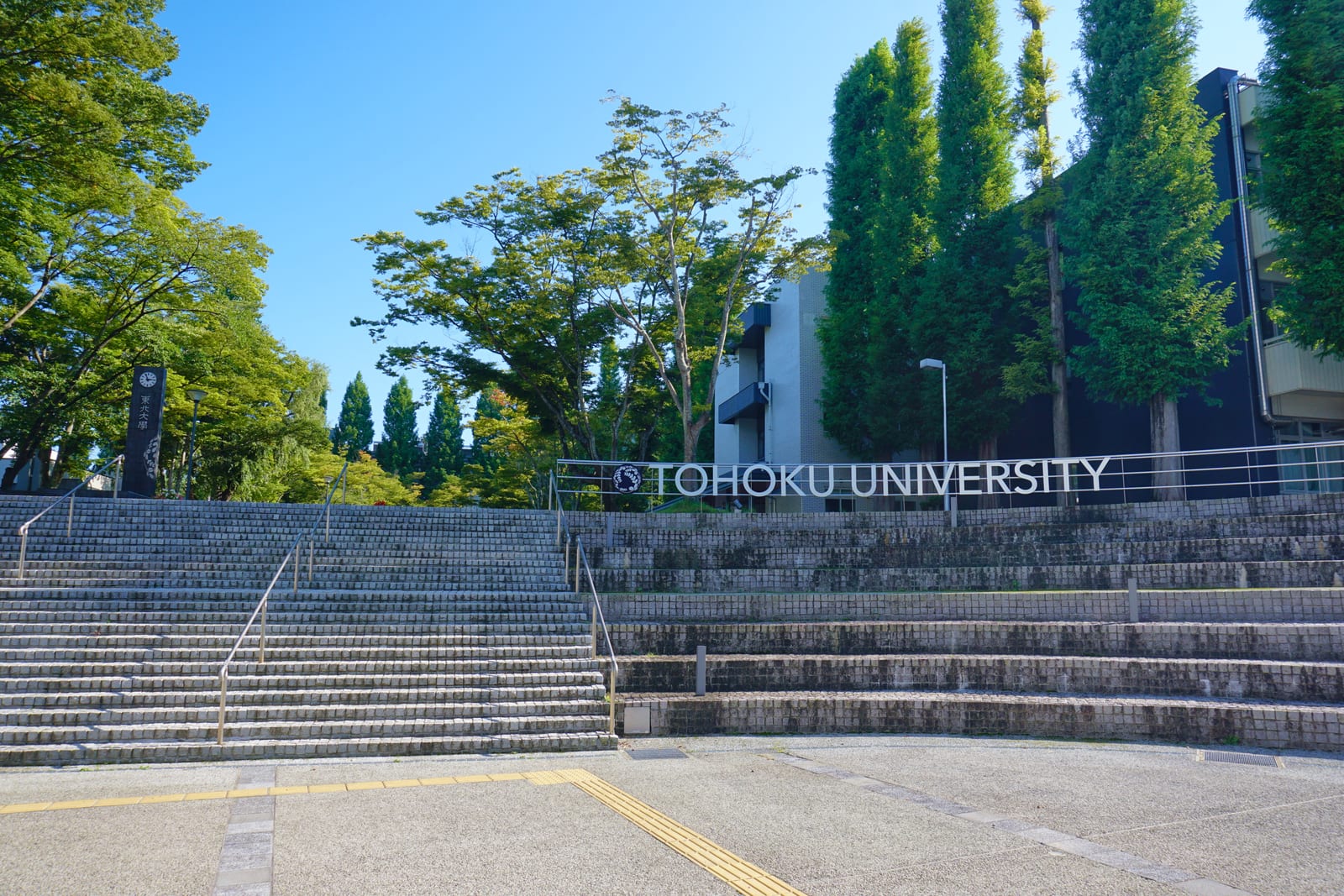
東北大学川内キャンパス Verified
東北大学川内キャンパス · Photo: 掬茶CC BY-SA 4.0
Applies everywhere on the site, on this device — change it any time.
Not set — every fee below is the international rate. Home and EU/EEA rates are often far lower.

courses

2 of 3

Bachelor's Degree · Mathematics, Physics, Chemistry, Biology & Life Sciences, Computer Science, Engineering (General)

International tuition

JP¥535,800 per year

Published, undated

Same rate across the institution · All students — no separate international rate

Tohoku University publishes this figure without stating which year it applies to, so it may already be out of date. Treat it as a starting point and check the course page for the current rate. Flag it below if you know it has changed.

Tohoku is a Japanese national university and charges the standard national rate, the same to Japanese and international students -- its fee table is broken down by student type (Undergraduate, Graduate, Law School, Accounting School), never by nationality. Undergraduate tuition is 535,800 yen per year, with a one-off admission fee of 282,000 yen and an application fee of 17,000 yen on top. Tohoku states that students who find it difficult to pay for economic reasons may be granted a waiver of one third, one half or all of the tuition, and half or all of the entrance fee, on application and screening -- so the figure recorded here is the sticker rate. No academic year is attached to the table, hence undated.

Show the fee on the university's site

Gateway College is a new English-taught undergraduate track launching in April 2027 (its first Fall/Term II intake, aimed at international applicants, enrols October 2027); it expands on Tohoku University's outgoing Future Global Leadership (FGL) programme, whose last undergraduate intake was 2026. Gateway College's own richly-detailed Admission Requirements document for the Fall 2027 cycle does not state a tuition figure, and Tohoku University's general Fees & Expenses page (which is not Gateway-College-specific) states no academic year anywhere next to its numbers, so no dated internationalTuition figure could be recorded. That general schedule states: Application Fee 17,000 yen, Admission Fee 282,000 yen, Tuition 535,800 yen per year for undergraduates — identical to the standard national-university rate also published by the University of Tokyo (GSC) and Kyoto University (Kyoto iUP) elsewhere in this dataset, since Japan's Ministry of Education sets one tuition band most national universities adopt. Fee waivers (one-half or the entire admission fee; one-third, one-half, or the entire tuition fee) are available on financial need, by application. Tohoku University's own Admissions Center states that a 'Detailed Application Guide' carrying further specifics was expected in August 2026 (tentative) — worth checking for a dated, program-specific fee figure in a future pass.

Show the source
Intake
October 2027 (Term II (Fall Enrollment) — Gateway College's first intake aimed at international applicants)
Source
Taught in
English
Source
Application deadline
Online application window: Noon (JST) 15 December 2026 to Noon (JST) 14 January 2027. 1st Stage Screening (document review) results announced 5 February 2027; 2nd Stage Screening (written examination and interview, both in English) held 21-22 February 2027; final results announced 24 March 2027; enrolment procedures 24 March-23 April 2027.
Source

What you'll study

Not yet added.

Entry requirementsEnglish · tests · grades · interview

English language

  • IELTS Academic, 6 overallIELTS Indicator and IELTS One Skill Retake scores are not accepted.
  • TOEFL iBT, 80 overall4.0 for tests conducted in January 2026 or later (ETS's rescaled TOEFL). TOEFL iBT MyBest, TOEFL ITP and TOEIC scores are not accepted. Duolingo English Test 110, Cambridge English (B2 First/C1 Advanced/C2 Proficiency) 169, or EIKEN Grade Pre-1 (2,400) / Grade 1 (2,400) are also accepted alternatives. Applicants are exempted if they completed at least 3 years of formal English-medium education in the 4 academic years before graduating high school.
Source

Admissions tests

  • SAT requiredApplicants must submit results from exactly one academic qualification system: SAT/Digital SAT (total 1,400+), ACT (Composite 31+), EJU (Basic Academic Ability Mathematics + Science total 300+, examination language English), AP (grade 4+ in each required subject), IB (36/42 total across six subjects, TOK+EE combined 2+), or International/GCE A-Level (at least three grades of A or higher). For the STEM track, the required subjects are Math + Science (ACT), Mathematics Course 2 + two of Physics/Chemistry/Biology (EJU), Calculus AB or BC + a lab science (AP), or HL Mathematics (AA) + two Science subjects with at least one at HL (IB). Superscores are not accepted for SAT or ACT.
Source

Academic offer

You must fulfil (or expect to fulfil by 30 September 2027) one of five routes: (A) a 12-year school curriculum completed outside Japan, or a MEXT-recognised equivalent; (B) an IB Diploma, German Abitur, French Baccalauréat, European Baccalaureate, GCE/International A-Level, or a 12-year curriculum at a school accredited by WASC, ACSI, CIS, NEASC, Cognia or COBIS; (C) a MEXT-designated international school in Japan (plus a University Preparatory Course if under 12 years); (D) school education completed in Japan under specific conditions; or (E) academic ability individually judged equivalent by Tohoku University, with the applicant at least 18 by 30 September 2027 (requires contacting the Admission Division at least one month before applications open).
Source
Convert your grade to compare →

Interview

The 2nd Stage Screening consists of a written examination (mathematical thinking, basic natural sciences, logical reasoning, for the STEM track) and an interview assessing communication skills, creativity, and interest in global issues. Both are conducted entirely in English for the Fall Enrollment cycle.
Source

Master's and Doctoral Degree · Mechanical Engineering, Aerospace Engineering

International tuition

JP¥535,800 per year

Published, undated

Same rate across the institution · All students — no separate international rate

Tohoku University publishes this figure without stating which year it applies to, so it may already be out of date. Treat it as a starting point and check the course page for the current rate. Flag it below if you know it has changed.

Tohoku is a Japanese national university and charges the standard national rate, the same to Japanese and international students, matching the rate already recorded for Tohoku's Gateway College and School of Medicine entries. IMAC-G's own admission page states a JPY 30,000 examination fee, a one-off JPY 282,000 entrance fee, and JPY 535,800 tuition per year (paid as two instalments of JPY 267,900). No academic year is attached to the figures, hence undated. Unlike the discontinued IMAC-U undergraduate track (last admission 2026, succeeded by Gateway College), IMAC-G continues to recruit new Master's and Doctoral students.

Show the fee on the university's site
Intake
October
Source
Taught in
English
Source
Application deadline
For the October 2026 enrollment round: application submission 9:00 on June 8 to 16:00 on June 18, 2026 (Japan time), with entrance examination 25-27 August 2026 and final results announced 2 September 2026.
Source

What you'll study

Not yet added.

Advertisement

More about Tohoku University

Student body

QS's own figures · QS World University Rankings 2027

Students
17,975
International students
1,806
≈10% of the student body (worked out here)
Faculty
2,999
International faculty
13%

These come from QS, not the university's own pages. Unlike every fee and deadline on this site. QS is the primary source for its own rankings and measurements, which is why it is cited here and rejected everywhere else.

Show the QS profile

About & contact

Sendai, Japan· view on Google Maps ↗tohoku.ac.jp

Find nearby

These open a map search near Sendai. StudyPath isn't listing or vouching for specific places — what the university itself publishes about on-campus facilities appears under On-campus amenities, cited like everything else here.

No admissions email, phone number, or address verified for this university yet. Not yet collected, not necessarily unavailable.

Accommodation

JP¥24,400–JP¥24,800per month

University House Sanjo on-campus dormitory, single rooms Type A and Type B (rent only; a separate monthly maintenance fee of 2,800-3,500 yen also applies)

  • Single (Type A), 10m²JP¥24,400
  • Single (Type B), 13m²JP¥24,800

Published by the university itself, not a live listings price. Actual cost depends on room type, availability and when you apply.

Show the source

After you graduate

Rules read 19 Aug 2026

What Japan's own immigration authority currently publishes. Not a ranking, not a guarantee, and not the same as what any agent or forum will tell you. Whether someone actually obtains residence depends on occupation, points, funds and policy that can change between application and graduation.

Work during study

A 'Student' (留学) status-of-residence holder has no work rights by default and must separately obtain 'Permission to Engage in Activities Other Than Those Permitted under the Status of Residence Previously Granted' (資格外活動許可) from the Immigration Services Agency before taking any paid work. The general permit (包括許可) that covers ordinary part-time work caps income-generating activity at 28 hours per week, rising to 8 hours per day (i.e. up to 40 hours in a normal week) during the educational institution's long vacation periods. Work in an establishment affecting public morals (e.g. adult entertainment or nightlife venues) is barred outright regardless of hours. A student intending to work must apply in person (or through an approved intermediary such as their school) at the regional immigration bureau, presenting their residence card; there is no fee.

Show the source

Post-study work visa

未来創造人材制度 (J-Find) — Designated Activities status for graduates of top-ranked universities . Up to 2 years
Introduced April 2023, J-Find grants a 'Designated Activities' status to someone who meets all three published conditions: (1) they graduated from — or completed a graduate-level degree or professional degree at — a university placed in the top 100 by at least two of three named world university rankings (QS World University Rankings, THE World University Rankings, or the Shanghai Ranking's Academic Ranking of World Universities); (2) they are within 5 years of that graduation; and (3) they hold at least JPY 200,000 to cover their initial cost of living in Japan. The status permits job-hunting, business-start-up preparation, and paid work needed to fund those activities (not open-ended employment), for up to 2 years total, renewed every 6 or 12 months. A dependent spouse or child can accompany the holder on their own Designated Activities status, though a dependant's own work still requires the separate 資格外活動許可 permission described under workDuringStudy. Japan does not otherwise publish a general post-study job-search visa open to every graduate — J-Find and the narrower 'Designated Activities (Continuing Job Hunting)' status (available to a graduate of any Japanese university or vocational school, not gated on world rankings, but requiring the school's own recommendation and continued job-hunting activity) are the two published routes; the broader one gated on ranking and no school recommendation is J-Find, cited here.

Show the source

Route to permanent residence

The realistic route from studying in Japan to permanent residence runs through the Highly Skilled Professional (高度専門職) points system, in place since 2012. A points calculation covering academic background, professional career, annual salary, age, research achievements, and other factors that reaches 70 gives 'Highly Skilled Professional (i)' status, which itself already carries a uniform maximum 5-year period of stay and other privileges (multi-track activities, a spouse able to work without meeting the usual credential requirements, and conditional accompaniment of parents or a household employee). The Immigration Services Agency's own published preferential-treatment page states the key relaxation directly: ordinary permanent residence in Japan requires, in principle, 10 or more consecutive years of residence, but someone who has continuously carried out Highly Skilled Professional activity for 3 years becomes eligible for permanent residence — and someone recognised as especially highly skilled within that group (80 or more points) becomes eligible after just 1 continuous year. A recent graduate does not qualify for Highly Skilled Professional status purely by holding a degree; the points are earned through the job itself (salary, career history, research record) once employed, so a graduate typically needs to first secure qualifying work — commonly via the ordinary 'Engineer/Specialist in Humanities/International Services' work status — before points and the shortened PR clock can apply.

Show the source

Route to citizenship

Japanese nationality by naturalisation is granted at the discretion of the Minister of Justice under Article 4 of the Nationality Act, and its general conditions (Article 5) are published in English by the Ministry of Justice itself. An applicant must have been domiciled in Japan for 5 or more consecutive years while holding valid status of residence throughout; be at least 18 (lowered from 20 by an amendment effective 1 April 2022) and of full legal capacity under their home country's law; be of upright conduct (judged against criminal record, tax-payment status and general social conduct); and be able to secure a livelihood in Japan (a household test — an applicant with no income of their own can still meet it through a spouse's or relative's property or earning capacity). The decisive condition for a reader weighing this route is the 'prevention of multiple nationality' condition (Article 5, Paragraph 1, Item 5): an applicant must either already have no nationality, or must, in principle, lose their original nationality upon naturalising as Japanese — Japan does not recognise dual nationality as a general matter. The Ministry's own page carves out a narrow exception only for a person whose original country's law does not allow them to lose that nationality regardless of their own wishes, in which case naturalisation may still be permitted without meeting this condition. Some of these general conditions are relaxed for applicants with an existing special relationship to Japan (born in Japan, or with a Japanese spouse, child, or former Japanese national in their history) under separate provisions (Nationality Act Articles 6-8) — a status an international graduate would not typically hold.

Show the source

New entry added 19 August 2026. Two Japanese government domains already covered this dataset's existing IMMIGRATION_DOMAINS entry for Japan (isa.go.jp, mofa.go.jp); moj.go.jp (Ministry of Justice, the Immigration Services Agency's own parent ministry and the domain the Agency's own site now actually resolves to — see collection note below) is added alongside them. Collection note: the isa.go.jp URLs found by search consistently redirected to the Japanese-language moj.go.jp/isa/ homepage rather than the specific page — the Immigration Services Agency's site now lives at moj.go.jp/isa/ with isa.go.jp apparently retired or aliased; every citation in this entry was re-found and fetched at its working moj.go.jp/isa/ URL instead (confirmed correct via the project's browser fallback before switching back to the plain-HTTP fetcher, which worked once the right path was known). Three of the four citations here (workDuringStudy, postStudyWork, residencyRoute) are Japanese-language originals with no equivalent English-language page found stating the same figures directly — the same pattern already used elsewhere in this dataset for South Korea, Turkey, Italy, France and (this pass) China; the English in `value` is this project's own translation/paraphrase, not a literal quote. The J-Find citation (postStudyWork) was a binary PDF; it was downloaded and converted with pdftotext (poppler-utils, -enc UTF-8 -layout) and archived via fetch-source.mjs --save, the same pattern already documented in this dataset for Australian, Italian, Korean and Turkish government PDFs — the quote's own line breaks reflect the original two-column PDF layout interleaving the eligibility list with the activity/duration column next to it, preserved verbatim rather than reflowed. citizenshipRoute, by contrast, is cited to moj.go.jp's own clean English-language 'Nationality Q&A' page, needing no translation. inDemandOccupations is left null: the Highly Skilled Professional points system scores salary, education, career history, age and similar general factors rather than naming specific in-demand occupations the way Canada, Australia, the UK or Germany do, and this dataset found no separate published shortage-occupation list. naturalisationStatus set to 'published-route': the Ministry of Justice publishes real, followable general conditions (Article 5) even though naturalisation is stated as being at the Minister's discretion beyond meeting them ('even if these conditions are met, naturalization may not always be permitted' — the Ministry's own words) — per the doc comment on ResidencyPathway.naturalisationStatus, this field records only whether criteria are published, not a guarantee of the outcome. citizenshipTerms records route discretionary because naturalisation is granted at the Minister of Justice’s discretion under Nationality Act Article 4, on top of the Article 5 conditions; the conditions are published, the grant is the Minister’s. dualCitizenshipAllowed is false: the Article 5(1)(v) prevention-of-multiple-nationality condition requires an applicant to have no nationality or, in principle, to lose their existing one on naturalising.

Open the immigration authority's own page ↗
Advertisement

Student photos

Contributed by students and applicants. Not checked the way the campus photos above are, just real photos from people who've actually been here.

Loading…

What students say about Tohoku University

Opinions from students and applicants. Not checked against the university's own pages the way the fees and deadlines above are.

to write a review. Signing in with your university email marks you as a verified student here.

Loading reviews…