Still growing.New universities and courses are added most weekdays (not weekends), each checked against the university's own page before it goes live — worth checking back. Sources last read 1 Oct 2026. How we verify →

StudyPath
Not separately QS-rankedSault Ste. Marie, Ontario, Canada· QS World University Rankings 2027

Algoma University

What stands out

  • Below most in Canada

    ~CA$22,601a year, lowest here

    Undergraduate fees below 40 of the 48 other universities in Canada we have priced

    Its lowest-fee course is Biology (BSc). The cheapest in the country is UPEI, at CA$9,718 a year.

    See how it compares ↓

Algoma University, in Sault Ste. Marie, Ontario, Canada, has 12 undergraduate courses listed on StudyPath. International tuition is ~CA$22,601.26 a year. Algoma U publishes its own accommodation prices, from CA$2,886.30 per semester. All of them publish an application deadline. 4 named scholarships are recorded against these courses. Every figure above was read from Algoma U's own published pages and last checked on 20 September 2026.

Not in the QS World University Rankings. Searches of QS's own topuniversities.com rankings and university profiles return no entry or ranked position for Algoma University in the QS World University Rankings, the regional tables or the subject tables.

Courses
12
Fees verified
12 / 12
Scholarship entries
48
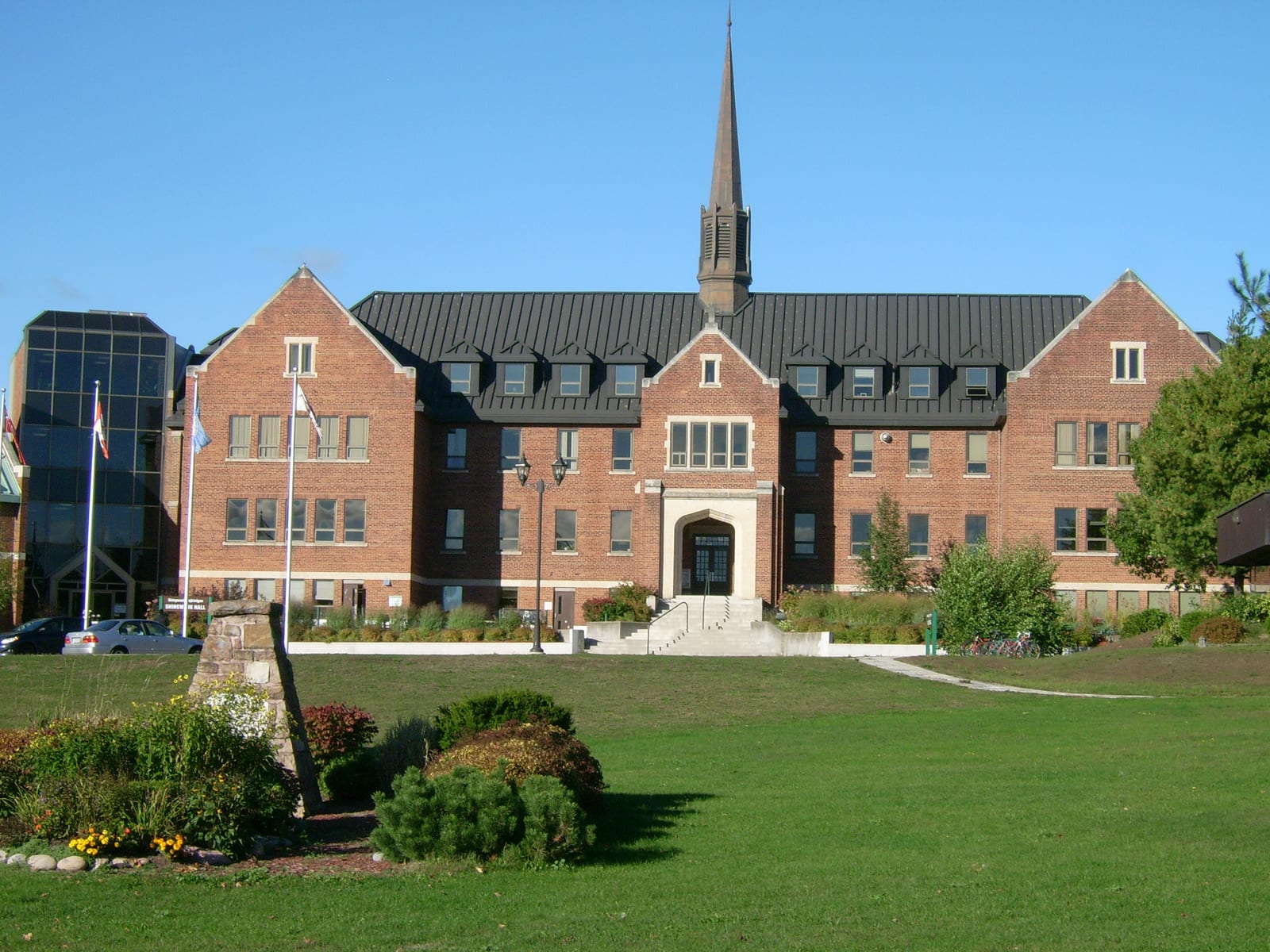
Algoma University, Sault Ste. Marie, Ontario. Verified
Algoma University, Sault Ste. Marie, Ontario. · Photo: Fungus GuyCC BY-SA 3.0
Applies everywhere on the site, on this device — change it any time.
Not set — every fee below is the international rate. Home and EU/EEA rates are often far lower.

courses

12 courses

Co-operative Education

B.Cosc. · 4 years · Computer Science

International tuition

CA$11,300.63 per term

~CA$90,400 for the whole 4 years, at today's fee
Verified

2026/27 · Same rate across the institution · International students

Algoma publishes one international undergraduate rate for a full-time 15-credit term, not a per-programme price — this figure is not specific to this degree. The rate rises within the year: $10,762.50 per term for the 2026 Spring term, $11,300.63 per term for 2026 Fall and 2027 Winter (the figure recorded here). A normal Fall+Winter year is therefore about CAD $22,601 in tuition. Compulsory ancillary fees of $485.51 per term are charged on top, plus UHIP health insurance at $316 per term from 2026 Fall and VIP insurance at $320 per year. Selected Biology, Chemistry, Computer Science, Environmental Science and Physics courses also carry a $22 lab/studio fee per 3-credit course.

Show the fee on the university's site

Algoma's figure is the 2026-2027 rate approved by its Board of Governors, and the Board reserves the right to amend fees at any time without prior notice.

Show the source
Intake
September 2026 (September 2026 Intake), January 2027 (January 2027 Intake)
Source
Application deadline
International applicants, September 2026 intake: last day to apply July 1, 2026; tuition deposit and acceptance by July 15, 2026; visa stamp and documents by September 9, 2026 (first day of classes). January 2027 intake: last day to apply November 18, 2026; deposit and acceptance by December 9, 2026; documents by January 6, 2027.
Source

What you'll study

Not yet added.

Scholarships4 available
  • Chancellor's Award

    CAD $5,000 per academic year, renewable for up to three additional years (CAD $20,000 total)

    Eligibility: New international students entering the first year of an undergraduate degree direct from secondary school, enrolled full-time (15 credits per term over Fall/Winter), with an A+ average — stated by Algoma as approximately 90–100% on the top 6 Grade 12 U/M courses, IB diploma points of 40–45, or A-Level grades of A* + A. This award additionally requires IELTS overall 7.0 with no band less than 6, above the normal admission bar.

    Renewal requires 30 credits across Fall and Winter in first year (24 credits thereafter) and a minimum 80% average in the previous Fall and Winter semesters. Applicants who meet the academic bar but not the higher English bar may instead be considered for the President’s Award. Algoma states entrance and renewal scholarships are under review for 2027-28 and may change.

    Source
  • President's Award

    CAD $2,500, paid once (non-renewable)

    Eligibility: New international students entering the first year of an undergraduate degree direct from secondary school, enrolled full-time (12 credits per term over Fall/Winter), with an A / A– average — stated by Algoma as approximately 85–89% on the top 6 Grade 12 U/M courses, IB diploma points of 37–39, or A-Level grades of A + A.

    Can be combined with the International Scholars Degree Award, athletic awards and other bursaries. Cannot be deferred to a later year.

    Source
  • Dean's Award

    CAD $1,000, paid once (non-renewable)

    Eligibility: New international students entering the first year of an undergraduate degree direct from secondary school, enrolled full-time (12 credits per term over Fall/Winter), with a B+ average — stated by Algoma as approximately 80–84% on the top 6 Grade 12 U/M courses, IB diploma points of 34–36, or A-Level grades of B + A or B + B.

    Source
  • Award of Excellence

    CAD $500, paid once (non-renewable)

    Eligibility: New international students entering the first year of an undergraduate degree direct from secondary school, enrolled full-time (12 credits per term over Fall/Winter), with a B average — stated by Algoma as approximately 75–79% on the top 6 Grade 12 U/M courses, IB diploma points of 31–33, or A-Level grades of B + C or C + C.

    Source

Industry placement

Requirement not stated

Co-operative Education

Published for this course

Show the source
✓ Word for wordRead 18 Aug 2026
“The new Computer Science Co-operative Education Programs offers students a degree with academic co-op credit embedded into the program.”
Computer Science | Algoma Universityalgomau.ca
Open the official page ↗

Recorded as not-stated deliberately: Algoma describes a co-op version of the computer science degree without saying anywhere on this page whether students on it must complete the work terms or opt into them.

What Algoma U publishes about how the placement works. Not a promise of a job. Employment rates and salaries are deliberately not recorded here; earnings figures on this site come only from national statistics agencies.

Entry requirementsEnglish · grades

English language

  • IELTS Academic, 6 overall, no band below 6.0
  • Duolingo English Test, 110 overall, no band below 90
  • Pearson Test of English, 60 overall
  • CAEL, 60 overall
Source

Academic offer

GCE A-Level route: two academic Advanced Level subjects with grades no lower than D, plus IGCSE/O-Level results. Mathematics is the named AS/A2 prerequisite for the Bachelor of Computer Science. IB route: IB Diploma with a minimum of 26 points plus prerequisites.
Source
Convert your grade to compare →

BSc · 4 years · Computer Science

International tuition

CA$11,300.63 per term

~CA$90,400 for the whole 4 years, at today's fee
Verified

2026/27 · Same rate across the institution · International students

Algoma publishes one international undergraduate rate for a full-time 15-credit term, not a per-programme price — this figure is not specific to this degree. The rate rises within the year: $10,762.50 per term for the 2026 Spring term, $11,300.63 per term for 2026 Fall and 2027 Winter (the figure recorded here). A normal Fall+Winter year is therefore about CAD $22,601 in tuition. Compulsory ancillary fees of $485.51 per term are charged on top, plus UHIP health insurance at $316 per term from 2026 Fall and VIP insurance at $320 per year. Selected Biology, Chemistry, Computer Science, Environmental Science and Physics courses also carry a $22 lab/studio fee per 3-credit course.

Show the fee on the university's site

Algoma's figure is the 2026-2027 rate approved by its Board of Governors, and the Board reserves the right to amend fees at any time without prior notice.

Show the source
Intake
September 2026 (September 2026 Intake), January 2027 (January 2027 Intake)
Source
Application deadline
International applicants, September 2026 intake: last day to apply July 1, 2026; tuition deposit and acceptance by July 15, 2026; visa stamp and documents by September 9, 2026 (first day of classes). January 2027 intake: last day to apply November 18, 2026; deposit and acceptance by December 9, 2026; documents by January 6, 2027.
Source

What you'll study

Not yet added.

Scholarships4 available
  • Chancellor's Award

    CAD $5,000 per academic year, renewable for up to three additional years (CAD $20,000 total)

    Eligibility: New international students entering the first year of an undergraduate degree direct from secondary school, enrolled full-time (15 credits per term over Fall/Winter), with an A+ average — stated by Algoma as approximately 90–100% on the top 6 Grade 12 U/M courses, IB diploma points of 40–45, or A-Level grades of A* + A. This award additionally requires IELTS overall 7.0 with no band less than 6, above the normal admission bar.

    Renewal requires 30 credits across Fall and Winter in first year (24 credits thereafter) and a minimum 80% average in the previous Fall and Winter semesters. Applicants who meet the academic bar but not the higher English bar may instead be considered for the President’s Award. Algoma states entrance and renewal scholarships are under review for 2027-28 and may change.

    Source
  • President's Award

    CAD $2,500, paid once (non-renewable)

    Eligibility: New international students entering the first year of an undergraduate degree direct from secondary school, enrolled full-time (12 credits per term over Fall/Winter), with an A / A– average — stated by Algoma as approximately 85–89% on the top 6 Grade 12 U/M courses, IB diploma points of 37–39, or A-Level grades of A + A.

    Can be combined with the International Scholars Degree Award, athletic awards and other bursaries. Cannot be deferred to a later year.

    Source
  • Dean's Award

    CAD $1,000, paid once (non-renewable)

    Eligibility: New international students entering the first year of an undergraduate degree direct from secondary school, enrolled full-time (12 credits per term over Fall/Winter), with a B+ average — stated by Algoma as approximately 80–84% on the top 6 Grade 12 U/M courses, IB diploma points of 34–36, or A-Level grades of B + A or B + B.

    Source
  • Award of Excellence

    CAD $500, paid once (non-renewable)

    Eligibility: New international students entering the first year of an undergraduate degree direct from secondary school, enrolled full-time (12 credits per term over Fall/Winter), with a B average — stated by Algoma as approximately 75–79% on the top 6 Grade 12 U/M courses, IB diploma points of 31–33, or A-Level grades of B + C or C + C.

    Source
Entry requirementsEnglish · grades

English language

  • IELTS Academic, 6 overall, no band below 6.0
  • Duolingo English Test, 110 overall, no band below 90
  • Pearson Test of English, 60 overall
  • CAEL, 60 overall
Source

Academic offer

GCE A-Level route: two academic Advanced Level subjects with grades no lower than D, plus IGCSE/O-Level results. For the Bachelor of Science in Computer Science the named AS/A2 prerequisites are Mathematics and two sciences (Biology, Chemistry or Physics) — a stricter bar than the B.Cosc., which requires Mathematics only.
Source
Convert your grade to compare →

B.Cosc. · 4 years · Computer Science

International tuition

CA$11,300.63 per term

~CA$90,400 for the whole 4 years, at today's fee
Verified

2026/27 · Same rate across the institution · International students

A named specialization inside the four-year Bachelor of Computer Science (B.Cosc.), not a separate degree — Algoma lists four (computer game technology, Data Science and AI, mobile software engineering, XR Technologies) on the same programme page. Algoma publishes one international undergraduate rate for a full-time 15-credit term, not a per-programme price — this figure is not specific to this degree. The rate rises within the year: $10,762.50 per term for the 2026 Spring term, $11,300.63 per term for 2026 Fall and 2027 Winter (the figure recorded here). A normal Fall+Winter year is therefore about CAD $22,601 in tuition. Compulsory ancillary fees of $485.51 per term are charged on top, plus UHIP health insurance at $316 per term from 2026 Fall and VIP insurance at $320 per year. Selected Biology, Chemistry, Computer Science, Environmental Science and Physics courses also carry a $22 lab/studio fee per 3-credit course.

Show the fee on the university's site

Algoma's figure is the 2026-2027 rate approved by its Board of Governors, and the Board reserves the right to amend fees at any time without prior notice.

Show the source
Intake
September 2026 (September 2026 Intake), January 2027 (January 2027 Intake)
Source
Application deadline
International applicants, September 2026 intake: last day to apply July 1, 2026; tuition deposit and acceptance by July 15, 2026; visa stamp and documents by September 9, 2026 (first day of classes). January 2027 intake: last day to apply November 18, 2026; deposit and acceptance by December 9, 2026; documents by January 6, 2027.
Source

What you'll study

Not yet added.

Scholarships4 available
  • Chancellor's Award

    CAD $5,000 per academic year, renewable for up to three additional years (CAD $20,000 total)

    Eligibility: New international students entering the first year of an undergraduate degree direct from secondary school, enrolled full-time (15 credits per term over Fall/Winter), with an A+ average — stated by Algoma as approximately 90–100% on the top 6 Grade 12 U/M courses, IB diploma points of 40–45, or A-Level grades of A* + A. This award additionally requires IELTS overall 7.0 with no band less than 6, above the normal admission bar.

    Renewal requires 30 credits across Fall and Winter in first year (24 credits thereafter) and a minimum 80% average in the previous Fall and Winter semesters. Applicants who meet the academic bar but not the higher English bar may instead be considered for the President’s Award. Algoma states entrance and renewal scholarships are under review for 2027-28 and may change.

    Source
  • President's Award

    CAD $2,500, paid once (non-renewable)

    Eligibility: New international students entering the first year of an undergraduate degree direct from secondary school, enrolled full-time (12 credits per term over Fall/Winter), with an A / A– average — stated by Algoma as approximately 85–89% on the top 6 Grade 12 U/M courses, IB diploma points of 37–39, or A-Level grades of A + A.

    Can be combined with the International Scholars Degree Award, athletic awards and other bursaries. Cannot be deferred to a later year.

    Source
  • Dean's Award

    CAD $1,000, paid once (non-renewable)

    Eligibility: New international students entering the first year of an undergraduate degree direct from secondary school, enrolled full-time (12 credits per term over Fall/Winter), with a B+ average — stated by Algoma as approximately 80–84% on the top 6 Grade 12 U/M courses, IB diploma points of 34–36, or A-Level grades of B + A or B + B.

    Source
  • Award of Excellence

    CAD $500, paid once (non-renewable)

    Eligibility: New international students entering the first year of an undergraduate degree direct from secondary school, enrolled full-time (12 credits per term over Fall/Winter), with a B average — stated by Algoma as approximately 75–79% on the top 6 Grade 12 U/M courses, IB diploma points of 31–33, or A-Level grades of B + C or C + C.

    Source
Entry requirementsEnglish · grades

English language

  • IELTS Academic, 6 overall, no band below 6.0
  • Duolingo English Test, 110 overall, no band below 90
  • Pearson Test of English, 60 overall
  • CAEL, 60 overall
Source

Academic offer

GCE A-Level route: two academic Advanced Level subjects with grades no lower than D, plus IGCSE/O-Level results. Mathematics is the named AS/A2 prerequisite for the Bachelor of Computer Science.
Source
Convert your grade to compare →

B.Cosc. · 4 years · Data Science & AI, Computer Science

International tuition

CA$11,300.63 per term

~CA$90,400 for the whole 4 years, at today's fee
Verified

2026/27 · Same rate across the institution · International students

A named specialization inside the four-year Bachelor of Computer Science (B.Cosc.), not a separate degree — Algoma lists four (computer game technology, Data Science and AI, mobile software engineering, XR Technologies) on the same programme page. Algoma publishes one international undergraduate rate for a full-time 15-credit term, not a per-programme price — this figure is not specific to this degree. The rate rises within the year: $10,762.50 per term for the 2026 Spring term, $11,300.63 per term for 2026 Fall and 2027 Winter (the figure recorded here). A normal Fall+Winter year is therefore about CAD $22,601 in tuition. Compulsory ancillary fees of $485.51 per term are charged on top, plus UHIP health insurance at $316 per term from 2026 Fall and VIP insurance at $320 per year. Selected Biology, Chemistry, Computer Science, Environmental Science and Physics courses also carry a $22 lab/studio fee per 3-credit course.

Show the fee on the university's site

Algoma's figure is the 2026-2027 rate approved by its Board of Governors, and the Board reserves the right to amend fees at any time without prior notice.

Show the source
Intake
September 2026 (September 2026 Intake), January 2027 (January 2027 Intake)
Source
Application deadline
International applicants, September 2026 intake: last day to apply July 1, 2026; tuition deposit and acceptance by July 15, 2026; visa stamp and documents by September 9, 2026 (first day of classes). January 2027 intake: last day to apply November 18, 2026; deposit and acceptance by December 9, 2026; documents by January 6, 2027.
Source

What you'll study

Not yet added.

Scholarships4 available
  • Chancellor's Award

    CAD $5,000 per academic year, renewable for up to three additional years (CAD $20,000 total)

    Eligibility: New international students entering the first year of an undergraduate degree direct from secondary school, enrolled full-time (15 credits per term over Fall/Winter), with an A+ average — stated by Algoma as approximately 90–100% on the top 6 Grade 12 U/M courses, IB diploma points of 40–45, or A-Level grades of A* + A. This award additionally requires IELTS overall 7.0 with no band less than 6, above the normal admission bar.

    Renewal requires 30 credits across Fall and Winter in first year (24 credits thereafter) and a minimum 80% average in the previous Fall and Winter semesters. Applicants who meet the academic bar but not the higher English bar may instead be considered for the President’s Award. Algoma states entrance and renewal scholarships are under review for 2027-28 and may change.

    Source
  • President's Award

    CAD $2,500, paid once (non-renewable)

    Eligibility: New international students entering the first year of an undergraduate degree direct from secondary school, enrolled full-time (12 credits per term over Fall/Winter), with an A / A– average — stated by Algoma as approximately 85–89% on the top 6 Grade 12 U/M courses, IB diploma points of 37–39, or A-Level grades of A + A.

    Can be combined with the International Scholars Degree Award, athletic awards and other bursaries. Cannot be deferred to a later year.

    Source
  • Dean's Award

    CAD $1,000, paid once (non-renewable)

    Eligibility: New international students entering the first year of an undergraduate degree direct from secondary school, enrolled full-time (12 credits per term over Fall/Winter), with a B+ average — stated by Algoma as approximately 80–84% on the top 6 Grade 12 U/M courses, IB diploma points of 34–36, or A-Level grades of B + A or B + B.

    Source
  • Award of Excellence

    CAD $500, paid once (non-renewable)

    Eligibility: New international students entering the first year of an undergraduate degree direct from secondary school, enrolled full-time (12 credits per term over Fall/Winter), with a B average — stated by Algoma as approximately 75–79% on the top 6 Grade 12 U/M courses, IB diploma points of 31–33, or A-Level grades of B + C or C + C.

    Source
Entry requirementsEnglish · grades

English language

  • IELTS Academic, 6 overall, no band below 6.0
  • Duolingo English Test, 110 overall, no band below 90
  • Pearson Test of English, 60 overall
  • CAEL, 60 overall
Source

Academic offer

GCE A-Level route: two academic Advanced Level subjects with grades no lower than D, plus IGCSE/O-Level results. Mathematics is the named AS/A2 prerequisite for the Bachelor of Computer Science.
Source
Convert your grade to compare →

B.Cosc. · 4 years · Computer Science

International tuition

CA$11,300.63 per term

~CA$90,400 for the whole 4 years, at today's fee
Verified

2026/27 · Same rate across the institution · International students

A named specialization inside the four-year Bachelor of Computer Science (B.Cosc.), not a separate degree — Algoma lists four (computer game technology, Data Science and AI, mobile software engineering, XR Technologies) on the same programme page. Algoma publishes one international undergraduate rate for a full-time 15-credit term, not a per-programme price — this figure is not specific to this degree. The rate rises within the year: $10,762.50 per term for the 2026 Spring term, $11,300.63 per term for 2026 Fall and 2027 Winter (the figure recorded here). A normal Fall+Winter year is therefore about CAD $22,601 in tuition. Compulsory ancillary fees of $485.51 per term are charged on top, plus UHIP health insurance at $316 per term from 2026 Fall and VIP insurance at $320 per year. Selected Biology, Chemistry, Computer Science, Environmental Science and Physics courses also carry a $22 lab/studio fee per 3-credit course.

Show the fee on the university's site

Algoma's figure is the 2026-2027 rate approved by its Board of Governors, and the Board reserves the right to amend fees at any time without prior notice.

Show the source
Intake
September 2026 (September 2026 Intake), January 2027 (January 2027 Intake)
Source
Application deadline
International applicants, September 2026 intake: last day to apply July 1, 2026; tuition deposit and acceptance by July 15, 2026; visa stamp and documents by September 9, 2026 (first day of classes). January 2027 intake: last day to apply November 18, 2026; deposit and acceptance by December 9, 2026; documents by January 6, 2027.
Source

What you'll study

Not yet added.

Scholarships4 available
  • Chancellor's Award

    CAD $5,000 per academic year, renewable for up to three additional years (CAD $20,000 total)

    Eligibility: New international students entering the first year of an undergraduate degree direct from secondary school, enrolled full-time (15 credits per term over Fall/Winter), with an A+ average — stated by Algoma as approximately 90–100% on the top 6 Grade 12 U/M courses, IB diploma points of 40–45, or A-Level grades of A* + A. This award additionally requires IELTS overall 7.0 with no band less than 6, above the normal admission bar.

    Renewal requires 30 credits across Fall and Winter in first year (24 credits thereafter) and a minimum 80% average in the previous Fall and Winter semesters. Applicants who meet the academic bar but not the higher English bar may instead be considered for the President’s Award. Algoma states entrance and renewal scholarships are under review for 2027-28 and may change.

    Source
  • President's Award

    CAD $2,500, paid once (non-renewable)

    Eligibility: New international students entering the first year of an undergraduate degree direct from secondary school, enrolled full-time (12 credits per term over Fall/Winter), with an A / A– average — stated by Algoma as approximately 85–89% on the top 6 Grade 12 U/M courses, IB diploma points of 37–39, or A-Level grades of A + A.

    Can be combined with the International Scholars Degree Award, athletic awards and other bursaries. Cannot be deferred to a later year.

    Source
  • Dean's Award

    CAD $1,000, paid once (non-renewable)

    Eligibility: New international students entering the first year of an undergraduate degree direct from secondary school, enrolled full-time (12 credits per term over Fall/Winter), with a B+ average — stated by Algoma as approximately 80–84% on the top 6 Grade 12 U/M courses, IB diploma points of 34–36, or A-Level grades of B + A or B + B.

    Source
  • Award of Excellence

    CAD $500, paid once (non-renewable)

    Eligibility: New international students entering the first year of an undergraduate degree direct from secondary school, enrolled full-time (12 credits per term over Fall/Winter), with a B average — stated by Algoma as approximately 75–79% on the top 6 Grade 12 U/M courses, IB diploma points of 31–33, or A-Level grades of B + C or C + C.

    Source
Entry requirementsEnglish · grades

English language

  • IELTS Academic, 6 overall, no band below 6.0
  • Duolingo English Test, 110 overall, no band below 90
  • Pearson Test of English, 60 overall
  • CAEL, 60 overall
Source

Academic offer

GCE A-Level route: two academic Advanced Level subjects with grades no lower than D, plus IGCSE/O-Level results. Mathematics is the named AS/A2 prerequisite for the Bachelor of Computer Science.
Source
Convert your grade to compare →

B.Cosc. · 4 years · Computer Science

International tuition

CA$11,300.63 per term

~CA$90,400 for the whole 4 years, at today's fee
Verified

2026/27 · Same rate across the institution · International students

A named specialization inside the four-year Bachelor of Computer Science (B.Cosc.), not a separate degree — Algoma lists four (computer game technology, Data Science and AI, mobile software engineering, XR Technologies) on the same programme page. Algoma publishes one international undergraduate rate for a full-time 15-credit term, not a per-programme price — this figure is not specific to this degree. The rate rises within the year: $10,762.50 per term for the 2026 Spring term, $11,300.63 per term for 2026 Fall and 2027 Winter (the figure recorded here). A normal Fall+Winter year is therefore about CAD $22,601 in tuition. Compulsory ancillary fees of $485.51 per term are charged on top, plus UHIP health insurance at $316 per term from 2026 Fall and VIP insurance at $320 per year. Selected Biology, Chemistry, Computer Science, Environmental Science and Physics courses also carry a $22 lab/studio fee per 3-credit course.

Show the fee on the university's site

Algoma's figure is the 2026-2027 rate approved by its Board of Governors, and the Board reserves the right to amend fees at any time without prior notice.

Show the source
Intake
September 2026 (September 2026 Intake), January 2027 (January 2027 Intake)
Source
Application deadline
International applicants, September 2026 intake: last day to apply July 1, 2026; tuition deposit and acceptance by July 15, 2026; visa stamp and documents by September 9, 2026 (first day of classes). January 2027 intake: last day to apply November 18, 2026; deposit and acceptance by December 9, 2026; documents by January 6, 2027.
Source

What you'll study

Not yet added.

Scholarships4 available
  • Chancellor's Award

    CAD $5,000 per academic year, renewable for up to three additional years (CAD $20,000 total)

    Eligibility: New international students entering the first year of an undergraduate degree direct from secondary school, enrolled full-time (15 credits per term over Fall/Winter), with an A+ average — stated by Algoma as approximately 90–100% on the top 6 Grade 12 U/M courses, IB diploma points of 40–45, or A-Level grades of A* + A. This award additionally requires IELTS overall 7.0 with no band less than 6, above the normal admission bar.

    Renewal requires 30 credits across Fall and Winter in first year (24 credits thereafter) and a minimum 80% average in the previous Fall and Winter semesters. Applicants who meet the academic bar but not the higher English bar may instead be considered for the President’s Award. Algoma states entrance and renewal scholarships are under review for 2027-28 and may change.

    Source
  • President's Award

    CAD $2,500, paid once (non-renewable)

    Eligibility: New international students entering the first year of an undergraduate degree direct from secondary school, enrolled full-time (12 credits per term over Fall/Winter), with an A / A– average — stated by Algoma as approximately 85–89% on the top 6 Grade 12 U/M courses, IB diploma points of 37–39, or A-Level grades of A + A.

    Can be combined with the International Scholars Degree Award, athletic awards and other bursaries. Cannot be deferred to a later year.

    Source
  • Dean's Award

    CAD $1,000, paid once (non-renewable)

    Eligibility: New international students entering the first year of an undergraduate degree direct from secondary school, enrolled full-time (12 credits per term over Fall/Winter), with a B+ average — stated by Algoma as approximately 80–84% on the top 6 Grade 12 U/M courses, IB diploma points of 34–36, or A-Level grades of B + A or B + B.

    Source
  • Award of Excellence

    CAD $500, paid once (non-renewable)

    Eligibility: New international students entering the first year of an undergraduate degree direct from secondary school, enrolled full-time (12 credits per term over Fall/Winter), with a B average — stated by Algoma as approximately 75–79% on the top 6 Grade 12 U/M courses, IB diploma points of 31–33, or A-Level grades of B + C or C + C.

    Source
Entry requirementsEnglish · grades

English language

  • IELTS Academic, 6 overall, no band below 6.0
  • Duolingo English Test, 110 overall, no band below 90
  • Pearson Test of English, 60 overall
  • CAEL, 60 overall
Source

Academic offer

GCE A-Level route: two academic Advanced Level subjects with grades no lower than D, plus IGCSE/O-Level results. Mathematics is the named AS/A2 prerequisite for the Bachelor of Computer Science.
Source
Convert your grade to compare →

How Algoma U compares

Against the other universities in Canada on StudyPath, using each one's verified international fees and its own published housing prices. Universities are only compared with others charging in the same currency (and, for housing, for the same period), so no figure here has been converted. A ~ marks a year worked out from a per-term or whole-course fee.

Algoma U's lowest undergraduate fee for international students is ~CA$22,601 a year, for Biology (BSc). Of the 48 other universities in Canada we list with undergraduate fees in CAD, 40 charge more at their lowest, 8 charge less. Their lowest undergraduate fees run from CA$9,718 (UPEI) to CA$51,530.40 (UBC).

Student housing. Algoma U's own lowest published rate is CA$2,886.30 per semester. Of the 7 other universities in Canada we list that publish housing per semester in CAD, 2 charge more, 5 charge less. Their lowest published rates run from CA$1,299.60 (CMU Winnipeg) to CA$4,166 (UPEI).

Living costs. The living-cost figure for a student visa to Canada is CA$22,895 per year, on top of tuition (figure for for applications made on or after September 1; read 19 Aug 2026 from canada.ca). The authority attaches conditions that can change this amount; see them in full on student finance.

By subject
SubjectLowest fee hereAgainst other universities in CanadaTheir lowest fees
Biology & Life Sciencesundergraduate~CA$22,601Biology (BSc)41 of 48 charge moreCA$9,718 to CA$66,110
Computer Scienceundergraduate~CA$22,601Computer Science — Computer Game Technology Specialization39 of 46 charge moreCA$9,718 to CA$66,110
Accountingundergraduate~CA$22,601Business Administration39 of 43 charge moreCA$9,718 to CA$74,678.31
Business & Managementundergraduate~CA$22,601Business Administration36 of 41 charge moreCA$9,718 to CA$74,678.31
Earth & Environmentalundergraduate~CA$22,601Environmental Science (Honours BSc)27 of 32 charge moreCA$9,718 to CA$66,110
Economicsundergraduate~CA$22,601Economics24 of 26 charge more~CA$20,300 to CA$66,110

Subjects taught at Algoma U

Each one opens every course in that subject, at every university we hold, with the same verified fees.

Where these figures come from

8 sentences from Algoma U's own site each back several figures above. Each is quoted once here; every course that uses one still opens it and links to its own source page.

  1. Used for international fee on 12 courses

    “International and Graduate Certificate Programs: Credits Tuition Compulsory Ancillary Fees Total Per Term for 2026 Spring $10,762.50* $485.51** $11,248.01 Per Term for 2026 Fall & 2027 Winter $11,300.63* $485.51** $11,786.14”
    Tuition, Residence & Fees - Algoma Universityalgomau.caread 18 Aug 2026
    Open the official page ↗
  2. Used for application deadline on 12 courses, start dates on 12 courses

    “Application and Deposit Deadlines September 2026 Intake Last Day to Apply July 1, 2026 Tuition Deposit & Acceptance Deadline July 15, 2026 Visa Stamp & Document Submission Deadline September 9, 2026 First Day of Classes September 9, 2026 January 2027 Intake Last Day to Apply November 18, 2026 Tuition Deposit & Acceptance Deadline December 9, 2026 Visa Stamp & Document Submission Deadline January 6, 2027 First Day of Classes January 6, 2027”
    Application Procedures for International Students - Algoma Universityalgomau.caread 18 Aug 2026
    Open the official page ↗
  3. Used for scholarship on 12 courses

    “Award Value Renewal Ontario High School Grade (OSSD) IB Diploma Points A-Level / AS-Level Grades Chancellor’s Award $5000 Renewable A+ (≈ 90–100%) 40-45 A* + A President’s Award $2500 Non-Renewable A / A– (≈ 85–89%) 37-39 A + A Dean’s Award $1000 Non-Renewable B+ (≈ 80–84%) 34-36 B + A or B + B Award of Excellence $500 Non-Renewable B (≈ 75–79%) 31-33 B + C or C + C”
    International Scholarships - Algoma Universityalgomau.caread 18 Aug 2026
    Open the official page ↗
  4. Used for cost note on 12 courses

    “*Undergraduate tuition applies to the 2026–2027 academic year, as approved by the Algoma University Board of Governors. The Board reserves the right to amend fees at any time without prior notice.”
    Tuition, Residence & Fees - Algoma Universityalgomau.caread 18 Aug 2026
    Open the official page ↗
  5. Used for entry requirements on 10 courses

    “Prerequisite Courses at AS Level or A2 Level* Bachelor of Arts, Music – An Audition with no specific AS/A2 Prerequisites Bachelor of Arts in Accounting, Economics or Finance & Economics – Mathematics All other Bachelor of Arts – No specific AS/A2 Prerequisites Bachelor of Business Administration – Mathematics Bachelor of Computer Science – Mathematics Bachelor of Science, Computer Science – Mathematics and two sciences (Biology, Chemistry or Physics) Bachelor of Fine Arts in Visual Arts – Portfolio Bachelor of Science, Biology – Mathematics, Biology, and Chemistry Bachelor of Science, Psychology – Mathematics, Biology, and Chemistry Bachelor of Science, Environmental Science – Mathematics, Biology, and Chemistry Bachelor of Social Work – No specific AS/A2 Prerequisites”
    International Admissions Requirements - Algoma Universityalgomau.caread 18 Aug 2026
    Open the official page ↗
  6. Used for entry requirements on 8 courses

    “All Other Undergraduate Programs Approved Test Minimum Requirement CAEL (paper-based, computer, or online) 60 Cambridge English Qualifications Overall 176, no band below 169 Duolingo English Test (DET) Overall 110, no band below 90 IELTS Academic (incl. IELTS Online) Overall 6.0, no band below 6.0 TOEFL 4 (ETS Code: 0820) Pearson Test of English (PTE Academic & Online) 60”
    English Language Proficiency Requirements - Algoma Universityalgomau.caread 18 Aug 2026
    Open the official page ↗
  7. Used for course length on 6 courses

    “Customize your degree to include something you love! Students enrolled in the four-year Bachelor of Computer Science (B.Cosc.) program can further enhance the quality of their degree by specializing in one of the four areas: computer game technology; Data Science and AI; mobile software engineering; or XR Technologies.”
    Computer Science - Algoma Universityalgomau.caread 18 Aug 2026
    Open the official page ↗
  8. Used for entry requirements on 2 courses

    “Programs with Higher English Requirements (BSc Biology, BA Psychology, BSc Psychology) Approved Test Minimum Requirement CAEL (paper-based, computer, or online) 60 Cambridge English Qualifications Overall 176, no band below 169 Duolingo English Test (DET) Overall 110, no band below 95 IELTS Academic (incl. IELTS Online) Overall 6.5, no band below 6.0 TOEFL (Computer or Home Edition) 4.5 (ETS Institution Code: 0820) Pearson Test of English (PTE Academic & Online) 60”
    English Language Proficiency Requirements - Algoma Universityalgomau.caread 18 Aug 2026
    Open the official page ↗

More about Algoma U

About & contact

Sault Ste. Marie, Ontario, Canada· view on Google Maps ↗algomau.ca ↗

Find nearby

These open a map search near Sault Ste. Marie, Ontario. StudyPath isn't listing or vouching for specific places — what the university itself publishes about on-campus facilities appears under On-campus amenities, cited like everything else here.

No admissions email, phone number, or address verified for this university yet. Not yet collected, not necessarily unavailable.

Accommodation

CA$2,886.30–CA$3,153.06per semester

on-campus residence, three buildings — every Algoma residence room is a private single room

  • Lou Lukenda Dormitory — private single room, international & Canadian student housing (meal plan mandatory)CA$2,886.30
  • Spirit Village Townhouse — private single room, townhouse-style (the only option with no mandatory meal plan)CA$2,939.65
  • Algoma Dormitory — private single room, first-year student housing (meal plan mandatory)CA$3,153.06

Rates are per semester and, per the same page, include the cost of the single room and utilities. A meal plan is mandatory in both dormitory-style buildings (Lou Lukenda and Algoma Dormitory) but not in the Spirit Village Townhouses: Plan A is $1,500.00 per semester on a declining balance, Plan B increases that to up to $3,000.00. On top of the room rate every resident also pays a refundable $250.00 damage deposit, a $25.00 Residence Life Fee and a non-refundable $50.00 residence application fee per semester. Two-semester (Fall/Winter) rates are slightly less than double the one-semester rate: $5,631.81, $5,735.91 and $6,152.31 respectively.

Published by the university itself, not a live listings price. Actual cost depends on room type, availability and when you apply.

Show the source
✓ Word for wordRead 18 Aug 2026
“Residence Building Residence Fees Damage Deposit* Residence Life Fee Meal Plan Options** Lou Lukenda Dormitory (International & Canadian student housing) 1 Semester $2,886.30 2 Semesters $5,631.81 $250.00 $25.00 Plan A Meal Plan: $1500.00 per semester on declining balance Plan B Meal Plan: Increase to plan A plan, up to $3000.00 2026 Spring Meal Plan Form 2026-27 Fall/Winter Meal Plan Form (Due: August 21st, 2026) A meal plan is mandatory for all students assigned to a dormitory style building. Algoma Dormitory (First-year student housing) 1 Semester $3,153.06 2 Semesters $6,152.31 $250.00 $25.00 Spirit Village Townhouse 1 Semester $2,939.65 2 Semesters $5,735.91 $250.00 $25.00”
Residence Fees & Meal Plans - Algoma Universityalgomau.ca
Open the official page ↗

Search student housing near Sault Ste. Marie, Ontario → (partner link)

After you graduate

Rules read 16 Aug 2026. Check the current rules, this may be out of date

What Canada's own immigration authority currently publishes. Not a ranking, not a guarantee, and not the same as what any agent or forum will tell you. Whether someone actually obtains residence depends on occupation, points, funds and policy that can change between application and graduation.

Money you must prove before the visa

CA$22,895per year, for a single applicant with no accompanying family members, covering the first year of the programme — and explicitly EXCLUDING tuition and transportation, which must be shown on top

Shown as a balance in a bank account. You keep control of it.

Figure published for: for applications made on or after September 1, 2025, in IRCC's own wording; the page was last modified 2026-01-26 and states 'These amounts are updated each year'. The previous figure, for applications between January 1, 2024 and August 31, 2025, was $20,635. This amount is revised regularly, so check it again before you transfer anything.

Applies to every province and territory EXCEPT Quebec; a student going to Quebec needs a Certificat d'acceptation du Québec and must meet costs set separately by the Ministère de l'Immigration, de la Francisation et de l'Intégration, which IRCC does not publish. The figure is living expenses only — tuition and return transportation for the applicant and any accompanying family are additional. Accompanying family raises it: $28,502 for 2 people, $35,040 for 3, $42,543 for 4, $48,252 for 5, $54,420 for 6, $60,589 for 7, and $6,170 for each further person. Funds must be available without working in Canada. Proof is needed for the first year; for a programme longer than a year the applicant must also explain how the rest will be paid. IRCC accepts several forms of proof and mandates none: bank statements for the past 4 months, a guaranteed investment certificate (GIC) from a participating Canadian financial institution, proof the first year of tuition and housing is already paid, a student or education loan, a bank draft convertible to Canadian dollars, a letter from a person or institution providing the money, or proof of a Canadian-funded scholarship. Local visa offices can require more, and an applicant from a country with foreign-exchange controls must also prove the money can legally be exported.

Show the source
✓ Word for wordRead 19 Aug 2026
“If you apply on or after September 1, 2025 All provinces and territories except Quebec Number of family members (including the applicant) Amount required per year (excluding tuition and transportation costs) (in CAN$) 1 $22,895”
Study permit: Proof of financial support - Canada.ca (Immigration, Refugees and Citizenship Canada)canada.ca
Open the official page ↗
Compare this against other countries →

Work during study

International students on a study permit may work off campus without a separate work permit if they are a full-time student at a designated learning institution (DLI), enrolled in a post-secondary academic, vocational or professional program (or a Quebec secondary-level vocational program) that is at least 6 months long and leads to a degree, diploma or certificate, hold a valid study permit with work conditions printed on it, and have a Social Insurance Number (SIN). During regular school terms or semesters they may work up to 24 hours per week off campus (across more than one job if needed). During scheduled breaks in the school year — such as summer and winter holidays or a reading week — they may work unlimited hours off campus. Working more than 24 hours per week during a term is a violation of study permit conditions.

Show the source
✓ Word for wordRead 16 Aug 2026
“During regular school terms or semesters You can work up to 24 hours per week . You can work more than 1 job to make up these hours as long as you continue to meet the conditions of your study permit. If your current study permit says that you may only work 20 hours per week off campus ( for example ), you're allowed to work up to 24 hours per week as long as you continue to meet the eligibility requirements . "May work 20 hours per week off campus or full-time during regular breaks if meeting criteria outlined in paragraph 186(v) of the Immigration and Refugee Protection Regulations ." During scheduled breaks in the school year If you're working during a break scheduled by your DLI, such as summer and winter holidays, or a reading week, you can work unlimited hours off campus”
Work off campus as an international student - Canada.cacanada.ca
Open the official page ↗

Post-study work visa

Post-Graduation Work Permit (PGWP) . Up to 3 years
Available to eligible graduates of designated learning institutions (not every institution or program qualifies). Permit length depends on the level and duration of the study program (and the passport's expiry date, whichever is shorter): a program of at least 8 months but under 2 years gets a PGWP up to the same length as the program; a program of 2 years or more gets a PGWP valid for 3 years. Graduates with a bachelor's, master's or doctoral degree face no field-of-study eligibility restriction (a restriction that does apply, since 1 November 2024, to some non-degree college/polytechnic programs), but all applicants now generally need a minimum Canadian Language Benchmark (CLB) 7 language-test result (CLB 5 for non-university college/polytechnic graduates) unless their PGWP application was submitted before 1 November 2024.

Show the source
✓ Word for wordRead 16 Aug 2026
“If your program was 2 years or more We may give you a PGWP that's valid for 3 years.”
Post-graduation work permit: About the post-graduation work permit (PGWP) - Canada.cacanada.ca
Open the official page ↗

Route to permanent residence

Express Entry's Canadian Experience Class (CEC) is a federal permanent-residence stream for people with qualifying Canadian work experience — the kind of experience a Post-Graduation Work Permit lets a graduate accumulate. To be eligible, the work experience must be paid, gained in Canada while authorized to work, in a National Occupational Classification (NOC) Training/Education/Experience/Responsibilities (TEER) category of 0, 1, 2 or 3, and total at least 1 year of full-time work (or the part-time equivalent — 1,560 hours) within the 3 years before applying. There is no minimum education requirement for the CEC stream itself, and a successful applicant must intend to live outside Quebec, which runs its own skilled-worker selection process.

Show the source
✓ Word for wordRead 16 Aug 2026
“Your skilled work experience must: be in 1 or more of these NOC categories: training, education, experience and responsibilities (TEER) 0, 1, 2, or 3 Your experience can be in more than 1 NOC. be gained by working in Canada while authorized to work under temporary resident status If you worked remotely, you must have been physically in Canada and working for a Canadian employer. show that you performed: the actions in the lead statement of the NOC job description, and most of the main duties listed be paid work (you must have been paid wages or earned commission—volunteer work or unpaid internships don't count) be at least 1 year of work or 1,560 hours total (30 hours per week) in the 3 years before you apply”
Express Entry: Who can apply - Canadian Experience Class - Canada.cacanada.ca
Open the official page ↗

Route to citizenship

Canadian citizenship is administered by the same department that runs immigration, Immigration, Refugees and Citizenship Canada (IRCC). An adult applicant must have been physically present in Canada for at least 1,095 days (3 years) during the 5 years immediately before signing the application; time spent in Canada as a temporary resident or protected person before becoming a permanent resident counts at half value toward this, capped at 365 of the 1,095 days. Applicants must have filed Canadian income taxes, if required to, for at least 3 of those 5 years. Applicants aged 18 to 54 must demonstrate English or French to at least Canadian Language Benchmark (CLB) / Niveaux de compétence linguistique canadien (NCLC) level 4, and must pass a citizenship test on the rights and responsibilities of citizens and on Canada's history, geography, government, laws and symbols; applicants 55 and over are exempt from both the language proof and the test. All adult applicants take the oath of citizenship at a ceremony. Canada permits dual and multiple citizenship: on this same page IRCC states plainly that becoming a Canadian citizen does not require giving up another nationality, while flagging that a person's other country of citizenship may not reciprocate that position.

Show the source
✓ Word for wordRead 17 Aug 2026
“You must have been physically in Canada for at least 1,095 days (3 years) during your 5-year eligibility period .”
Apply for Canadian citizenship: adults and minor children: Who can apply - Canada.cacanada.ca
Open the official page ↗

What the government currently prioritises

Express Entry (the federal system covering the Canadian Experience Class, Federal Skilled Worker Program and Federal Skilled Trades Program) periodically runs category-based rounds of invitations that target published categories directly relevant to StudyPath’s fields: 'Healthcare and social services occupations' and 'Science, Technology, Engineering and Math (STEM) occupations', alongside separate categories for trade occupations, education, transport, French-language proficiency, and Canadian-experienced physicians, senior managers and researchers. Eligibility for either category requires at least 12 months of work experience within the past 3 years in a single occupation named on IRCC's published table for that round, identified by National Occupational Classification (NOC) code. The STEM table has included, among others, architecture and science managers, cybersecurity specialists, civil/mechanical/electrical-and-electronics/industrial-and-manufacturing engineers, geological engineers, and civil/mechanical/electrical engineering technologists and technicians. The healthcare and social services table has included, among others, specialists in clinical/laboratory medicine and in surgery, general practitioners and family physicians, dentists, optometrists, pharmacists, psychologists, physiotherapists, occupational therapists, registered nurses and registered psychiatric nurses, nurse practitioners, licensed practical nurses, dental hygienists and dental therapists, medical laboratory and medical radiation technologists, and social workers — and a separate category exists specifically for 'Physicians with Canadian work experience'. Which categories run, and which occupations are listed, is decided round by round and is not guaranteed for any particular occupation.

Show the source
✓ Word for wordRead 16 Aug 2026
“Current categories French-language proficiency Healthcare and social services occupations Science, Technology, Engineering and Math (STEM) occupations Trade occupations Education occupations Transport occupations Physicians with Canadian work experience Senior managers with Canadian work experience Researchers with Canadian work experience Skilled military recruits”
Express Entry: Category-based selection - Canada.cacanada.ca
Open the official page ↗

PGWP eligibility rules changed materially on 1 November 2024: most applicants must now show a minimum language-test result, and non-degree study-permit applicants from that date must be in a field of study linked to occupations in long-term shortage — this field-of-study requirement does not apply to bachelor's, master's or doctoral graduates. Category-based Express Entry rounds (including the STEM category) run at IRCC's discretion, are not on a fixed schedule, and are not guaranteed to recur for any given occupation. Read 16 August 2026; Canada has changed PGWP and Express Entry settings more than once in the last two years, so re-check before relying on this. Deepening pass, 17 August 2026: inDemandOccupations re-cited to the same already-archived category-based-selection.html page to add the Healthcare and social services occupations category (specific named occupations) alongside the STEM category that was already there — the page names both categories together, so a single quote listing the category names supports the expanded value; the occupation lists themselves come from tables already present in the same archived snapshot. citizenshipRoute added 17 August 2026, cited to the same canada.ca 'Who can apply' page already used above — that single page carries the physical-presence figure, the language/test age bands, the tax-filing rule and the dual-citizenship statement together, so one citation supports the whole field. naturalisationStatus set to 'published-route' on 18 August 2026: the authority already cited under citizenshipRoute publishes criteria a foreign resident could actually follow, which is the only claim this field makes. It is deliberately not a judgement about how attainable that route is in practice. studentVisaFunds added 19 August 2026. mechanism is recorded as bank-balance, not guaranteed-investment, and the reason matters: the Student Direct Stream — the route whose defining requirement was a CAN$20,635 GIC — no longer exists. IRCC's own student-direct-stream.html URL now serves the general study-permit hub with no SDS content on it at all (read the same day). A GIC is still listed on the proof-of-funds page as one of several accepted documents, but it is no longer attached to a faster stream and no longer a required mechanism, so recording 'guaranteed-investment' would describe a programme that has been withdrawn. Quebec is deliberately left without a figure: IRCC's page says only that Quebec applicants must meet costs set by the Ministère de l'Immigration, de la Francisation et de l'Intégration, and that ministry is not an allowlisted immigration domain here, so the Quebec amount was not collected rather than guessed. The $22,895 is the single-applicant row; the larger household figures are in conditions verbatim from the same table.

Open the immigration authority's own page ↗
Student photos

Contributed by students and applicants. Not checked the way the campus photos above are, just real photos from people who've actually been here.

Loading…

What students say about Algoma U

Opinions from students and applicants. Not checked against the university's own pages the way the fees and deadlines above are.

to write a review. Signing in with your university email marks you as a verified student here.

Loading reviews…