Still growing.New universities and courses are added most weekdays (not weekends), each checked against the university's own page before it goes live — worth checking back. Sources last read 1 Oct 2026. How we verify →

StudyPath
QS #70 (parent)Kunshan, Jiangsu, China· QS World University Rankings 2027

Duke Kunshan University

What stands out

  • Taught in English

    All 9courses

    Taught fully in English

    Across the 189 courses we list in China, 90 are not fully English-taught.

    See the courses ↓

Duke Kunshan University, in Kunshan, Jiangsu, China, has 9 undergraduate courses listed on StudyPath. International tuition is US$73,740 a year. DKU publishes its own accommodation prices, from CN¥8,250 per term. 8 of the 9 publish an application deadline. Every figure above was read from DKU's own published pages and last checked on 18 August 2026.

Duke Kunshan University does hold its own separate topuniversities.com profile (distinct from Duke University's), but that profile carries no QS World University Rankings position — its only listed placement is "#1501+ in QS Sustainability Ranking 2026", a different, much lower-profile QS table.

This is a branch campus of Duke University (Durham, NC campus) (QS #70. The whole institution's figure). Degrees, fees and admission here are set by this campus. The parent's position is shown for context only, never claimed as this campus's own. See above for how QS actually treats this campus.

Courses
9
Fees verified
9 / 9
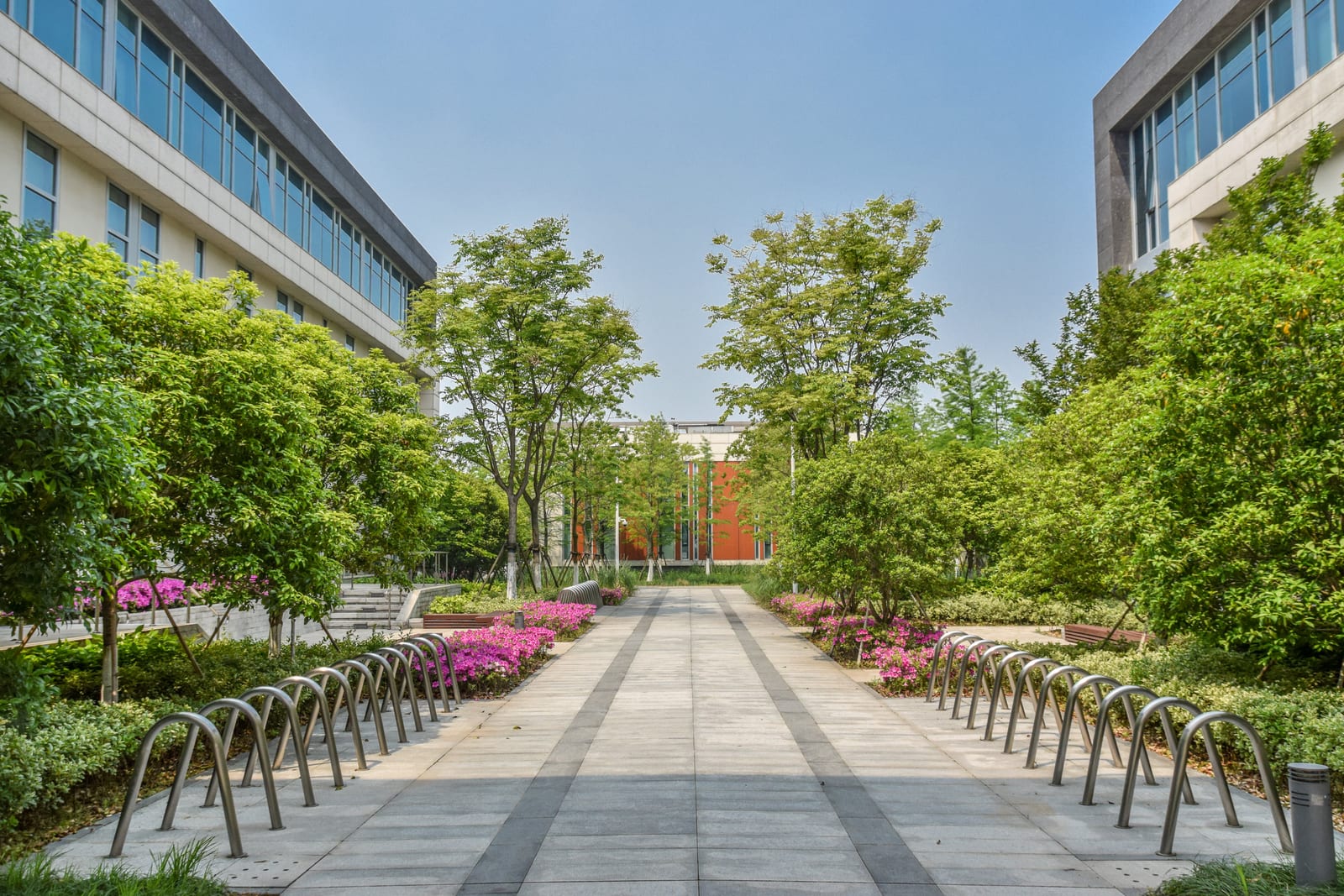
A three-story, 200-bed student residence with suites emulate the Unité model of Le Corbusier—each suite is entered from the second floor, with shared living on that level and four bedrooms (all singles) and two shared bathrooms above or below.
The Faculty Residence is a two-story building that has 16 units of faculty apartments, each with a live/work loft concept. Verified
A three-story, 200-bed student residence with suites emulate the Unité model of Le Corbusier—each suite is entered from the second floor, with shared living on that level and four bedrooms (all singles) and two shared bathrooms above or below. The Faculty Residence is a two-story building that has 16 units of faculty apartments, each with a live/work loft concept. · Photo: CrcolasCC BY-SA 4.0
Applies everywhere on the site, on this device — change it any time.
Not set — every fee below is the international rate. Home and EU/EEA rates are often far lower.

courses

9 courses

BS · 4 years · Mathematics, Computer Science

International tuition

US$73,740 per year

~US$295,000 for the whole 4 years, at today's fee
Verified

2026/27 · Same rate across the institution · International students

Tuition & Fees only; DKU's own cost table adds Insurance ($2,073), Room ($2,350), Books/supplies ($2,610) and Board ($3,292) on top, for a Total Estimated Cost of $84,065/year (excluding transportation). Students who complete the standard 4-year curriculum receive two bachelor's degrees, one from Duke Kunshan University and one from Duke University.

Show the fee on the university's site
Intake
Not verified
Taught in
English
Source
Application deadline
2027 Entry Term: Early Decision deadline November 2, 2026 (11:59pm ET); Regular Decision deadline January 4, 2027 (11:59pm ET). Applications open via the Common App from August 2026. No application fee.
Source

What you'll study

Not yet added.

Entry requirementsEnglish · tests · grades

English language

  • IELTS, 7 overallTest-optional: DKU does not require an English proficiency test, but recommends one for non-native speakers not studying in an English-medium curriculum. This is the minimum band score expected if IELTS is submitted.
  • TOEFL, 100 overallTest-optional (see IELTS note). Minimum score expected on the internet-based TOEFL before Jan. 21, 2026; a new 5-point scale applies after that date.
Source

Admissions tests

None required for this course, per the university.
Source

Academic offer

Holistic, Common-App-based admission: application, school report, counselor recommendation, and official secondary school transcripts (initial, mid-year if available, and final). No SAT/ACT required (test-optional for all applicants) and no single numeric GPA or grade-percentage bar is published.
Source
Convert your grade to compare →

BS · 4 years · Computer Science

International tuition

US$73,740 per year

~US$295,000 for the whole 4 years, at today's fee
Verified

2026/27 · Same rate across the institution · International students

Tuition & Fees only; DKU's own cost table adds Insurance ($2,073), Room ($2,350), Books/supplies ($2,610) and Board ($3,292) on top, for a Total Estimated Cost of $84,065/year (excluding transportation). Students who complete the standard 4-year curriculum receive two bachelor's degrees, one from Duke Kunshan University and one from Duke University.

Show the fee on the university's site
Intake
Not verified
Taught in
English
Source
Application deadline
2027 Entry Term: Early Decision deadline November 2, 2026 (11:59pm ET); Regular Decision deadline January 4, 2027 (11:59pm ET). Applications open via the Common App from August 2026. No application fee.
Source

What you'll study

Not yet added.

Entry requirementsEnglish · tests · grades

English language

  • IELTS, 7 overallTest-optional: DKU does not require an English proficiency test, but recommends one for non-native speakers not studying in an English-medium curriculum. This is the minimum band score expected if IELTS is submitted.
  • TOEFL, 100 overallTest-optional (see IELTS note). Minimum score expected on the internet-based TOEFL before Jan. 21, 2026; a new 5-point scale applies after that date.
Source

Admissions tests

None required for this course, per the university.
Source

Academic offer

Holistic, Common-App-based admission: application, school report, counselor recommendation, and official secondary school transcripts (initial, mid-year if available, and final). No SAT/ACT required (test-optional for all applicants) and no single numeric GPA or grade-percentage bar is published.
Source
Convert your grade to compare →

Data Science

BS · 4 years · Data Science & AI

International tuition

US$73,740 per year

~US$295,000 for the whole 4 years, at today's fee
Verified

2026/27 · Same rate across the institution · International students

Tuition & Fees only; DKU's own cost table adds Insurance ($2,073), Room ($2,350), Books/supplies ($2,610) and Board ($3,292) on top, for a Total Estimated Cost of $84,065/year (excluding transportation). Students who complete the standard 4-year curriculum receive two bachelor's degrees, one from Duke Kunshan University and one from Duke University.

Show the fee on the university's site
Intake
Not verified
Taught in
English
Source
Application deadline
2027 Entry Term: Early Decision deadline November 2, 2026 (11:59pm ET); Regular Decision deadline January 4, 2027 (11:59pm ET). Applications open via the Common App from August 2026. No application fee.
Source

What you'll study

Not yet added.

Entry requirementsEnglish · tests · grades

English language

  • IELTS, 7 overallTest-optional: DKU does not require an English proficiency test, but recommends one for non-native speakers not studying in an English-medium curriculum. This is the minimum band score expected if IELTS is submitted.
  • TOEFL, 100 overallTest-optional (see IELTS note). Minimum score expected on the internet-based TOEFL before Jan. 21, 2026; a new 5-point scale applies after that date.
Source

Admissions tests

None required for this course, per the university.
Source

Academic offer

Holistic, Common-App-based admission: application, school report, counselor recommendation, and official secondary school transcripts (initial, mid-year if available, and final). No SAT/ACT required (test-optional for all applicants) and no single numeric GPA or grade-percentage bar is published.
Source
Convert your grade to compare →

BS · 4 years · Earth & Environmental, Biology & Life Sciences, Chemistry

International tuition

US$73,740 per year

~US$295,000 for the whole 4 years, at today's fee
Verified

2026/27 · Same rate across the institution · International students

Tuition & Fees only; DKU's own cost table adds Insurance ($2,073), Room ($2,350), Books/supplies ($2,610) and Board ($3,292) on top, for a Total Estimated Cost of $84,065/year (excluding transportation). Students who complete the standard 4-year curriculum receive two bachelor's degrees, one from Duke Kunshan University and one from Duke University.

Show the fee on the university's site
Intake
Not verified
Taught in
English
Source
Application deadline
2027 Entry Term: Early Decision deadline November 2, 2026 (11:59pm ET); Regular Decision deadline January 4, 2027 (11:59pm ET). Applications open via the Common App from August 2026. No application fee.
Source

What you'll study

Not yet added.

Entry requirementsEnglish · tests · grades

English language

  • IELTS, 7 overallTest-optional: DKU does not require an English proficiency test, but recommends one for non-native speakers not studying in an English-medium curriculum. This is the minimum band score expected if IELTS is submitted.
  • TOEFL, 100 overallTest-optional (see IELTS note). Minimum score expected on the internet-based TOEFL before Jan. 21, 2026; a new 5-point scale applies after that date.
Source

Admissions tests

None required for this course, per the university.
Source

Academic offer

Holistic, Common-App-based admission: application, school report, counselor recommendation, and official secondary school transcripts (initial, mid-year if available, and final). No SAT/ACT required (test-optional for all applicants) and no single numeric GPA or grade-percentage bar is published.
Source
Convert your grade to compare →

Materials Science

BS · 4 years · Materials Science, Chemistry, Physics

International tuition

US$73,740 per year

~US$295,000 for the whole 4 years, at today's fee
Verified

2026/27 · Same rate across the institution · International students

Tuition & Fees only; DKU's own cost table adds Insurance ($2,073), Room ($2,350), Books/supplies ($2,610) and Board ($3,292) on top, for a Total Estimated Cost of $84,065/year (excluding transportation). Students who complete the standard 4-year curriculum receive two bachelor's degrees, one from Duke Kunshan University and one from Duke University.

Show the fee on the university's site
Intake
Not verified
Taught in
English
Source
Application deadline
2027 Entry Term: Early Decision deadline November 2, 2026 (11:59pm ET); Regular Decision deadline January 4, 2027 (11:59pm ET). Applications open via the Common App from August 2026. No application fee.
Source

What you'll study

Not yet added.

Entry requirementsEnglish · tests · grades

English language

  • IELTS, 7 overallTest-optional: DKU does not require an English proficiency test, but recommends one for non-native speakers not studying in an English-medium curriculum. This is the minimum band score expected if IELTS is submitted.
  • TOEFL, 100 overallTest-optional (see IELTS note). Minimum score expected on the internet-based TOEFL before Jan. 21, 2026; a new 5-point scale applies after that date.
Source

Admissions tests

None required for this course, per the university.
Source

Academic offer

Holistic, Common-App-based admission: application, school report, counselor recommendation, and official secondary school transcripts (initial, mid-year if available, and final). No SAT/ACT required (test-optional for all applicants) and no single numeric GPA or grade-percentage bar is published.
Source
Convert your grade to compare →

BS · 4 years · Biology & Life Sciences

International tuition

US$73,740 per year

~US$295,000 for the whole 4 years, at today's fee
Verified

2026/27 · Same rate across the institution · International students

Tuition & Fees only; DKU's own cost table adds Insurance ($2,073), Room ($2,350), Books/supplies ($2,610) and Board ($3,292) on top, for a Total Estimated Cost of $84,065/year (excluding transportation). Students who complete the standard 4-year curriculum receive two bachelor's degrees, one from Duke Kunshan University and one from Duke University.

Show the fee on the university's site
Intake
Not verified
Taught in
English
Source
Application deadline
2027 Entry Term: Early Decision deadline November 2, 2026 (11:59pm ET); Regular Decision deadline January 4, 2027 (11:59pm ET). Applications open via the Common App from August 2026. No application fee.
Source

What you'll study

Not yet added.

Entry requirementsEnglish · tests · grades

English language

  • IELTS, 7 overallTest-optional: DKU does not require an English proficiency test, but recommends one for non-native speakers not studying in an English-medium curriculum. This is the minimum band score expected if IELTS is submitted.
  • TOEFL, 100 overallTest-optional (see IELTS note). Minimum score expected on the internet-based TOEFL before Jan. 21, 2026; a new 5-point scale applies after that date.
Source

Admissions tests

None required for this course, per the university.
Source

Academic offer

Holistic, Common-App-based admission: application, school report, counselor recommendation, and official secondary school transcripts (initial, mid-year if available, and final). No SAT/ACT required (test-optional for all applicants) and no single numeric GPA or grade-percentage bar is published.
Source
Convert your grade to compare →

Subjects taught at DKU

Each one opens every course in that subject, at every university we hold, with the same verified fees.

Where these figures come from

7 sentences from DKU's own site each back several figures above. Each is quoted once here; every course that uses one still opens it and links to its own source page.

  1. Used for international fee on 9 courses

    “Tuition and Cost of Attendance Annual Costs for International Students 2026-2027 Academic Year Tuition & Fees $73,740”
    Tuition & Cost Of Attendance | Duke Kunshan Universityadmissions.dukekunshan.edu.cnread 18 Aug 2026
    Open the official page ↗
  2. Used for teaching language on 9 courses

    “The language of instruction at Duke Kunshan is English.”
    Frequently Asked Questions - International Admissions - Duke Kunshan Universityadmissions.dukekunshan.edu.cnread 20 Aug 2026
    Open the official page ↗
  3. Used for course length on 8 courses

    “Students who complete Duke Kunshan University’s 4-year undergraduate curriculum will receive two degrees, one from Duke University and one from Duke Kunshan University. A total of 136 Duke Kunshan University credits is required for graduation with a Duke Kunshan University bachel”
    Undergraduate Degree Program | Duke Kunshan Universityugstudies.dukekunshan.edu.cnread 17 Aug 2026
    Open the official page ↗
  4. Used for application deadline on 8 courses

    “Application Deadlines (2027 Entry Term): Early decision application deadline: November 2, 2026 (11:59pm ET) Regular decision application deadline: January 4, 2027 (11:59pm ET)”
    How to Apply | Duke Kunshan Universityadmissions.dukekunshan.edu.cnread 17 Aug 2026
    Open the official page ↗
  5. Used for entry requirements on 6 courses

    “– Duolingo (Minimum score expected is 130) – IELTS (Minimum band score expected is 7) – PTE Academic (Minimum score expected is 70) – TOEFL (Minimum scores expected: 5 after Jan. 21, 2026, or 100 before Jan. 21, 2026 on the internet-based TOEFL)”
    How to Apply | Duke Kunshan Universityadmissions.dukekunshan.edu.cnread 17 Aug 2026
    Open the official page ↗
  6. Used for entry requirements on 6 courses

    “The Duke Kunshan Admissions team takes a holistic approach when reviewing applications. This means that all application requirements are taken into consideration, ensuring the most suitable candidates are admitted on the strength of their application as a whole.”
    How to Apply | Duke Kunshan Universityadmissions.dukekunshan.edu.cnread 17 Aug 2026
    Open the official page ↗
  7. Used for entry requirements on 6 courses

    “Duke Kunshan will continue to offer a test-optional policy for the 2026-2027 application cycle. Based on their circumstances, applicants choose in the admission application whether or not they will provide their results from the SAT or ACT exams.”
    Test-optional Policy | Duke Kunshan Universityadmissions.dukekunshan.edu.cnread 17 Aug 2026
    Open the official page ↗

More about DKU

About & contact

Kunshan, Jiangsu, China· view on Google Maps ↗dukekunshan.edu.cn ↗

Find nearby

These open a map search near Kunshan, Jiangsu. StudyPath isn't listing or vouching for specific places — what the university itself publishes about on-campus facilities appears under On-campus amenities, cited like everything else here.

No admissions email, phone number, or address verified for this university yet. Not yet collected, not necessarily unavailable.

Accommodation

CN¥8,250–CN¥11,250per term

Duke Kunshan on-campus student residence charge for international undergraduates, per semester (two semesters in the academic year)

  • Double room, sharedCN¥8,250
  • Single roomCN¥11,250

There is no additional residence charge for students taking the required Chinese Society and Culture courses over the summer. DKU offers a payment plan letting international students spread tuition, fees and residence charges over four instalments a year (two per semester). The page also gives the equivalents in US dollars: 1,603 USD for a single room and 1,175 USD for a double, per semester.

Published by the university itself, not a live listings price. Actual cost depends on room type, availability and when you apply.

Show the source
✓ Word for wordRead 18 Aug 2026
“– Residence charge of single room is 11,250 RMB/1,603 USD per semester, double room is 8,250 RMB/1,175 USD per semester . There is no additional residence charge for students taking the required Chinese Society and Cultural courses during the summer.”
Duke Kunshan University — Tuition & Cost of Attendance (International Admissions)admissions.dukekunshan.edu.cn
Open the official page ↗

After you graduate

Rules read 19 Aug 2026. Check the current rules, this may be out of date

What China's own immigration authority currently publishes. Not a ranking, not a guarantee, and not the same as what any agent or forum will tell you. Whether someone actually obtains residence depends on occupation, points, funds and policy that can change between application and graduation.

Work during study

International students' work-study activity, on or off campus, is governed by a joint measure issued by the Ministry of Education, the Ministry of Public Security, the Ministry of Human Resources and Social Security and the National Immigration Administration (教育部办公厅等四部门关于印发《高等学校国际学生勤工助学管理办法》的通知, effective from 29 December 2021). In principle, it must not exceed 8 hours a week or 40 hours a month; during winter and summer holidays, the limit rises to 16 hours a week and 80 hours a month. To work off campus at all, a student must additionally be at least 18 years old, hold a valid study-category residence permit with at least 6 months of validity remaining, have studied continuously at their current institution for more than a year (covering undergraduate, postgraduate, further-study and visiting-scholar students), meet the school's own academic-progress and attendance standards, comply with Chinese law and school discipline, and meet any further condition the school itself sets. An off-campus arrangement must also be registered: within 10 days of signing an agreement with an employer, the student must apply to the local public security exit-entry authority to have the work unit and duration annotated on their residence permit, and an unannotated permit may not be used for off-campus work.

Show the source
✓ Word for wordRead 19 Aug 2026
“国际学生校内外勤工助学,原则上每周不超过8小时,每月不超过40小时。寒暑假期间,原则上每周不超过16小时,每月不超过80小时。”
教育部办公厅等四部门关于印发《高等学校国际学生勤工助学管理办法》的通知 - 中华人民共和国教育部政府门户网站moe.gov.cn
Open the official page ↗

Post-study work visa

Residence permit for private affairs, marked "entrepreneurship" (创业) — for graduates of Chinese higher education . Up to 5 years
China does not publish a general post-study job-search visa of the kind Canada, Australia, the UK or several other countries on StudyPath do; the National Immigration Administration's own guidance instead sets out a narrower, entrepreneurship-specific route. An outstanding foreign graduate with a bachelor's degree or higher from a 'key' Chinese institution of higher learning who goes on to engage in innovation and entrepreneurship in China can apply for a residence permit for private affairs, annotated "entrepreneurship," valid for two to five years, on presentation of their graduation certificate and innovation/entrepreneurship certificates. A separate, shorter version applies to a graduate of an "internationally renowned" university (Chinese or overseas) who comes to China to pursue innovation and entrepreneurship within two years of graduating: that residence permit is capped at two years, granted on the academic/degree certificate alone. Neither version is itself a work permit — a graduate who instead takes salaried employment with an enterprise or other entity must separately apply for the ordinary work-type residence permit like any other foreign employee.

Show the source
✓ Word for wordRead 19 Aug 2026
“Outstanding foreign students who have obtained a bachelor's degree or above from a key Chinese institution of higher learning and engage in innovation and entrepreneurship in China after graduation can apply for a residence permit for private affairs valid for two to five years (marked with "entrepreneurship") by presenting their university graduation certificate and certificates for innovation and entrepreneurship. Those who are employed by enterprises and other entities may apply for a work-type residence permit in accordance with relevant regulations.”
Entry-Exit and Stay (Residence) of Foreigners - National Immigration Administrationen.nia.gov.cn
Open the official page ↗

Route to permanent residence

China's permanent residence system (the 'Chinese green card,' formally the Certificate of Permanent Residence of Aliens) is governed by State Council-approved regulations administered by the Ministry of Public Security, and its published eligibility criteria — current on the National Immigration Administration's own site as of this reading — carry no study- or graduate-specific track at all. An applicant must be law-abiding, healthy and free of a criminal record, and meet one of a short, closed list of conditions: (1) direct, stable investment in China for three consecutive years running to a set minimum (from USD 500,000 in an encouraged industry or a western/poverty-relief county, up to USD 2 million elsewhere in the country), with a sound tax record; (2) at least four consecutive years in a senior post — deputy general manager, deputy factory director or higher, or an associate-professor/associate-research-fellow-equivalent post — at a qualifying institution, with at least 3 of those years actually spent in China and a sound tax record; (3) 'major and outstanding contributions to China' or being someone China 'urgently needs'; or (4)-(7) specific family-reunification grounds (spouse or unmarried minor child of someone in categories 1-3; spouse of a Chinese citizen or of a permanent resident after 5 years of marriage and 5 years' actual residence in China; a minor child joining a parent; or an elderly person over 60 with no direct relatives abroad joining relatives already in China, after 5 years' residence). A recent international graduate does not fit any of these categories on the strength of their degree alone — the entrepreneurship residence permit described under postStudyWork is a separate, temporary status, not permanent residence, and StudyPath found no published bridge connecting the two.

Show the source
✓ Word for wordRead 19 Aug 2026
“Aliens applying for permanent residence in China shall abide by Chinese laws, be healthy, have no criminal record and conform to any of the following terms and conditions: 1. having direct investment in China, stable investment in China for three years in a row, and having a sound taxation record; 2. having assumed the posts of deputy general manager or deputy director of plants or higher level posts or posts of associate professors or associate research fellows and similar posts for more than four years in a row, and the period of stay in accumulation being no shorter than three years and having sound taxation record; 3. having major and outstanding contributions to China or needed urgently by China;”
Regulations on Examination and Approval of Permanent Residence of Aliens in China - National Immigration Administrationen.nia.gov.cn
Open the official page ↗

Route to citizenship

Chinese nationality is governed by the Nationality Law of the People's Republic of China (in force since 1980), administered through the Ministry of Public Security's exit-entry system and China's diplomatic missions abroad; the National Immigration Administration publishes the law's text directly. Article 7 sets naturalisation eligibility for a foreign national or stateless person willing to abide by China's Constitution and laws to one of three grounds: being a near relative of a Chinese national, having settled in China, or having 'other legitimate reasons' — the law does not define 'settled in China' or 'other legitimate reasons' any further, and does not set out a route tied to studying or working in China as such. Article 8 then states the central, decisive condition for anyone considering it: a person whose naturalisation application is approved 'shall not retain foreign nationality' — made unambiguous elsewhere in the same law by Article 3, which states plainly that 'The People's Republic of China does not recognize dual nationality for any Chinese national.' A foreign graduate naturalising as Chinese must therefore give up their original nationality; there is no dual-citizenship option.

Show the source
✓ Word for wordRead 19 Aug 2026
“(1) they are near relatives of Chinese nationals; (2) they have settled in China; or (3) they have other legitimate reasons. Article 8 Any person who applies for naturalization as a Chinese national shall acquire Chinese nationality upon approval of his application; a person whose application for naturalization as a Chinese national has been approved shall not retain foreign nationality.”
Nationality Law of the People's Republic of China - National Immigration Administrationen.nia.gov.cn
Open the official page ↗

New entry added 19 August 2026. Two Chinese government domains accepted as a government source here: nia.gov.cn (National Immigration Administration, covering its en.nia.gov.cn English-language subdomain, the actual immigration/residence/nationality authority) and moe.gov.cn (Ministry of Education, the co-issuing authority for the international-student work-study measure and the natural authority for a rule specifically about students). workDuringStudy is cited to the Chinese-language original of the Ministry of Education notice (moe.gov.cn) because no equivalent English-language page stating the same figures directly was found on an official domain — the same approach already used elsewhere on StudyPath for South Korea, Turkey, Italy and France, where the archived quote is in the source's own language and the English is this project's translation/paraphrase in `value`, not a literal quote. inDemandOccupations is left null: StudyPath found no Chinese government page publishing a shortage-occupation or priority-sector list gating a specific visa or permit, unlike Canada, Australia, the UK or Germany. naturalisationStatus set to 'published-route': Article 7 of the Nationality Law states real conditions (near-relative ties, having settled in China, or an unspecified 'other legitimate reasons' ground) rather than nothing at all, even though — as recorded above — the law does not spell out a specific study- or work-based path the way an immigration-points system does, and China is widely understood to grant naturalisation only rarely; per the doc comment on ResidencyPathway.naturalisationStatus this field records only whether criteria are published, not how attainable the route is in practice. residencyRoute similarly records a published permanent-residence system that carries no study-or-graduate-specific ground — this is stated as what the regulation says, not as an editorial judgement that China is closed to graduates in practice. citizenshipTerms records minimumResidenceYears null because the Nationality Law publishes no residence period at all: Article 7 sets three qualifying grounds (near relative of a Chinese national, settled in China, other legitimate reasons) and never defines a number of years. Route is application because an individual applies to the authorities under Article 7 rather than being nominated.
Open the immigration authority's own page ↗

Student photos

Contributed by students and applicants. Not checked the way the campus photos above are, just real photos from people who've actually been here.

Loading…

What students say about DKU

Opinions from students and applicants. Not checked against the university's own pages the way the fees and deadlines above are.

to write a review. Signing in with your university email marks you as a verified student here.

Loading reviews…