Still growing.New universities and courses are added most weekdays (not weekends), each checked against the university's own page before it goes live — worth checking back. Sources last read 1 Oct 2026. How we verify →

StudyPath
QS #12Singapore, Singapore· QS World University Rankings 2027

Nanyang Technological University, Singapore (NTU Singapore)

Nanyang Technological University, Singapore (NTU Singapore), in Singapore, Singapore, has 19 undergraduate courses and 1 master's course listed on StudyPath. International tuition runs from ~SGD 36,350 to ~SGD 91,250 a year depending on the course. NTU Singapore publishes its own accommodation prices, from SGD 350 per month. 1 of the 20 publishes an application deadline. Every figure above was read from NTU Singapore's own published pages and last checked on 29 September 2026.

Courses
20
Fees verified
20 / 20
International tuition across 20 courses

~SGD 36,350to~SGD 91,250a year

Lowest: Psychology BSocSci (Hons)Highest: Bachelor of Medicine and Bachelor of Surgery MBBS
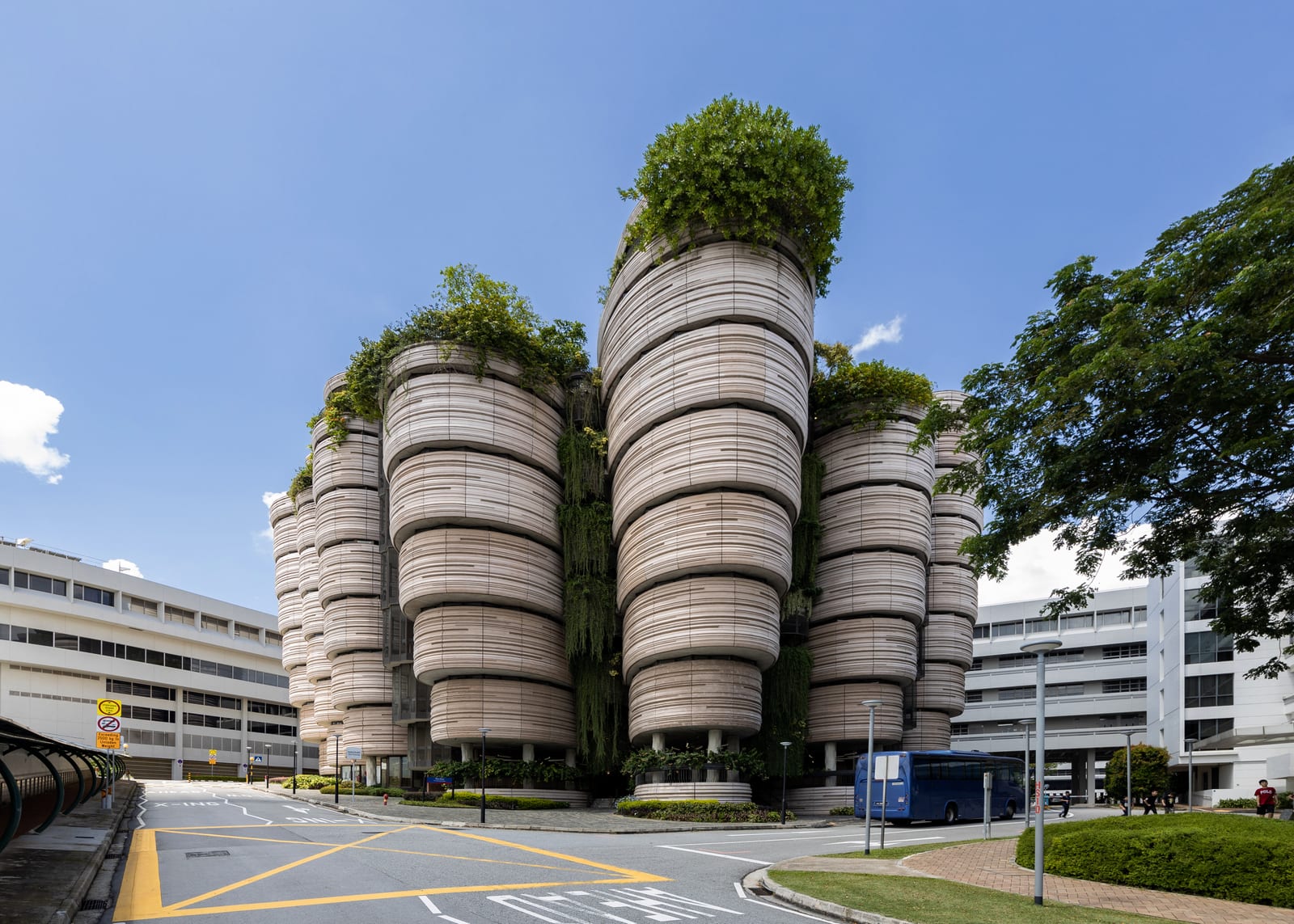
The Hive, also known as the Learning Hub, is a building located in Nanyang Technological University, Singapore. The S$45 million building was designed by Thomas Heatherwick and completed in 2015. Colloquially, the building is known as the "dim sum basket building" due to its likeness to the steamer baskets used to serve dim sum. The Hive was a finalist for the 2015 World Architecture Festival Commercial Mixed-Use Award in the Future Projects subcategory. Verified
The Hive, also known as the Learning Hub, is a building located in Nanyang Technological University, Singapore. The S$45 million building was designed by Thomas Heatherwick and completed in 2015. Colloquially, the building is known as the "dim sum basket building" due to its likeness to the steamer baskets used to serve dim sum. The Hive was a finalist for the 2015 World Architecture Festival Commercial Mixed-Use Award in the Future Projects subcategory. · Photo: This Photo was taken by Supanut Arunoprayote.CC BY 4.0
Applies everywhere on the site, on this device — change it any time.
Not set — every fee below is the international rate. Home and EU/EEA rates are often far lower.

courses

20 courses

Computer Science

BSc · 4 years · Computer Science

International tuition

SGD 40,600 per year

~SGD 162,400 for the whole 4 years, at today's fee
Verified

2026 · Faculty-wide rate · International students

NTU's fee table splits non-subsidised international tuition into 'Lab Based' (S$40,600/year) and 'Non-Lab Based' (S$36,350/year) tiers under the row 'All Programmes (except for those listed below)' -- the exceptions named elsewhere on the page are Accountancy/Business-related degrees, Medicine, and the Renaissance Engineering Programme, none of which this programme is. Engineering, natural-science and computing degrees are laboratory-based instruction, so the Lab Based figure applies here; NTU's page does not spell out the lab/non-lab designation by named school, so this is the collector's read of the general classification rather than a school-by-school statement. This is the NON-subsidised rate, i.e. what an international student pays without Singapore's MOE Tuition Grant. With the Tuition Grant the same seat costs S$18,050/year (ASEAN nationals) or S$21,400/year (all other international students, both inclusive of GST) -- but accepting the grant binds the (non-Singaporean) recipient to a three-year work-in-Singapore service obligation after graduating, so the subsidised figure is not recorded as the headline fee. 'Annual tuition fee is fixed at the 2026 rate for the duration of the degree programme' -- NTU labels this by admission cohort year ('Accepted Programme Offer in 2026') rather than an academic-year range, hence the period label rather than the academic year.

Show the fee on the university's site
Intake
Not verified
Application deadline
Not verified

What you'll study

Not yet added.

BEng · 4 years · Computer Science

International tuition

SGD 40,600 per year

~SGD 162,400 for the whole 4 years, at today's fee
Verified

2026 · Faculty-wide rate · International students

NTU's fee table splits non-subsidised international tuition into 'Lab Based' (S$40,600/year) and 'Non-Lab Based' (S$36,350/year) tiers under the row 'All Programmes (except for those listed below)' -- the exceptions named elsewhere on the page are Accountancy/Business-related degrees, Medicine, and the Renaissance Engineering Programme, none of which this programme is. Engineering, natural-science and computing degrees are laboratory-based instruction, so the Lab Based figure applies here; NTU's page does not spell out the lab/non-lab designation by named school, so this is the collector's read of the general classification rather than a school-by-school statement. This is the NON-subsidised rate, i.e. what an international student pays without Singapore's MOE Tuition Grant. With the Tuition Grant the same seat costs S$18,050/year (ASEAN nationals) or S$21,400/year (all other international students, both inclusive of GST) -- but accepting the grant binds the (non-Singaporean) recipient to a three-year work-in-Singapore service obligation after graduating, so the subsidised figure is not recorded as the headline fee. 'Annual tuition fee is fixed at the 2026 rate for the duration of the degree programme' -- NTU labels this by admission cohort year ('Accepted Programme Offer in 2026') rather than an academic-year range, hence the period label rather than the academic year.

Show the fee on the university's site
Intake
Not verified
Application deadline
Not verified

What you'll study

Not yet added.

BEng · 4 years · Electrical & Electronic Engineering

International tuition

SGD 40,600 per year

~SGD 162,400 for the whole 4 years, at today's fee
Verified

2026 · Faculty-wide rate · International students

NTU's fee table splits non-subsidised international tuition into 'Lab Based' (S$40,600/year) and 'Non-Lab Based' (S$36,350/year) tiers under the row 'All Programmes (except for those listed below)' -- the exceptions named elsewhere on the page are Accountancy/Business-related degrees, Medicine, and the Renaissance Engineering Programme, none of which this programme is. Engineering, natural-science and computing degrees are laboratory-based instruction, so the Lab Based figure applies here; NTU's page does not spell out the lab/non-lab designation by named school, so this is the collector's read of the general classification rather than a school-by-school statement. This is the NON-subsidised rate, i.e. what an international student pays without Singapore's MOE Tuition Grant. With the Tuition Grant the same seat costs S$18,050/year (ASEAN nationals) or S$21,400/year (all other international students, both inclusive of GST) -- but accepting the grant binds the (non-Singaporean) recipient to a three-year work-in-Singapore service obligation after graduating, so the subsidised figure is not recorded as the headline fee. 'Annual tuition fee is fixed at the 2026 rate for the duration of the degree programme' -- NTU labels this by admission cohort year ('Accepted Programme Offer in 2026') rather than an academic-year range, hence the period label rather than the academic year.

Show the fee on the university's site
Intake
Not verified
Application deadline
Not verified

What you'll study

Not yet added.

BEng · 4 years · Mechanical Engineering

International tuition

SGD 40,600 per year

~SGD 162,400 for the whole 4 years, at today's fee
Verified

2026 · Faculty-wide rate · International students

NTU's fee table splits non-subsidised international tuition into 'Lab Based' (S$40,600/year) and 'Non-Lab Based' (S$36,350/year) tiers under the row 'All Programmes (except for those listed below)' -- the exceptions named elsewhere on the page are Accountancy/Business-related degrees, Medicine, and the Renaissance Engineering Programme, none of which this programme is. Engineering, natural-science and computing degrees are laboratory-based instruction, so the Lab Based figure applies here; NTU's page does not spell out the lab/non-lab designation by named school, so this is the collector's read of the general classification rather than a school-by-school statement. This is the NON-subsidised rate, i.e. what an international student pays without Singapore's MOE Tuition Grant. With the Tuition Grant the same seat costs S$18,050/year (ASEAN nationals) or S$21,400/year (all other international students, both inclusive of GST) -- but accepting the grant binds the (non-Singaporean) recipient to a three-year work-in-Singapore service obligation after graduating, so the subsidised figure is not recorded as the headline fee. 'Annual tuition fee is fixed at the 2026 rate for the duration of the degree programme' -- NTU labels this by admission cohort year ('Accepted Programme Offer in 2026') rather than an academic-year range, hence the period label rather than the academic year.

Show the fee on the university's site
Intake
Not verified
Application deadline
Not verified

What you'll study

Not yet added.

Civil Engineering

BEng · 4 years · Civil Engineering

International tuition

SGD 40,600 per year

~SGD 162,400 for the whole 4 years, at today's fee
Verified

2026 · Faculty-wide rate · International students

NTU's fee table splits non-subsidised international tuition into 'Lab Based' (S$40,600/year) and 'Non-Lab Based' (S$36,350/year) tiers under the row 'All Programmes (except for those listed below)' -- the exceptions named elsewhere on the page are Accountancy/Business-related degrees, Medicine, and the Renaissance Engineering Programme, none of which this programme is. Engineering, natural-science and computing degrees are laboratory-based instruction, so the Lab Based figure applies here; NTU's page does not spell out the lab/non-lab designation by named school, so this is the collector's read of the general classification rather than a school-by-school statement. This is the NON-subsidised rate, i.e. what an international student pays without Singapore's MOE Tuition Grant. With the Tuition Grant the same seat costs S$18,050/year (ASEAN nationals) or S$21,400/year (all other international students, both inclusive of GST) -- but accepting the grant binds the (non-Singaporean) recipient to a three-year work-in-Singapore service obligation after graduating, so the subsidised figure is not recorded as the headline fee. 'Annual tuition fee is fixed at the 2026 rate for the duration of the degree programme' -- NTU labels this by admission cohort year ('Accepted Programme Offer in 2026') rather than an academic-year range, hence the period label rather than the academic year.

Show the fee on the university's site
Intake
Not verified
Application deadline
Not verified

What you'll study

Not yet added.

BEng · 4 years · Chemical Engineering

International tuition

SGD 40,600 per year

~SGD 162,400 for the whole 4 years, at today's fee
Verified

2026 · Faculty-wide rate · International students

NTU's fee table splits non-subsidised international tuition into 'Lab Based' (S$40,600/year) and 'Non-Lab Based' (S$36,350/year) tiers under the row 'All Programmes (except for those listed below)' -- the exceptions named elsewhere on the page are Accountancy/Business-related degrees, Medicine, and the Renaissance Engineering Programme, none of which this programme is. Engineering, natural-science and computing degrees are laboratory-based instruction, so the Lab Based figure applies here; NTU's page does not spell out the lab/non-lab designation by named school, so this is the collector's read of the general classification rather than a school-by-school statement. This is the NON-subsidised rate, i.e. what an international student pays without Singapore's MOE Tuition Grant. With the Tuition Grant the same seat costs S$18,050/year (ASEAN nationals) or S$21,400/year (all other international students, both inclusive of GST) -- but accepting the grant binds the (non-Singaporean) recipient to a three-year work-in-Singapore service obligation after graduating, so the subsidised figure is not recorded as the headline fee. 'Annual tuition fee is fixed at the 2026 rate for the duration of the degree programme' -- NTU labels this by admission cohort year ('Accepted Programme Offer in 2026') rather than an academic-year range, hence the period label rather than the academic year.

Show the fee on the university's site
Intake
Not verified
Application deadline
Not verified

What you'll study

Not yet added.

Subjects taught at NTU Singapore

Each one opens every course in that subject, at every university we hold, with the same verified fees.

Where these figures come from

3 sentences from NTU Singapore's own site each back several figures above. Each is quoted once here; every course that uses one still opens it and links to its own source page.

  1. Used for international fee on 12 courses

    “Programme of Study Subsidised Students Non-Subsidised Students 2 (not receiving tuition grant) (inclusive of GST) Singapore Citizens 1 Singapore Permanent Residents 1 ASEAN IS 2,3 (inclusive of GST) All Other IS 2 (inclusive of GST) Lab Based Non-Lab Based All Programmes (except for those listed below) $ 8,300 $ 11,600 $ 18,050 $ 21,400 $ 40,600 $ 36,350”
    Accepted Programme Offer in 2026 | NTU Singaporentu.edu.sgread 17 Aug 2026
    Open the official page ↗
  2. Used for course length on 10 courses

    “Annual tuition fee is fixed at the 2026 rate for the duration of the degree programme.”
    Accepted Programme Offer in 2026 | NTU Singaporentu.edu.sgread 17 Aug 2026
    Open the official page ↗
  3. Used for international fee on 5 courses

    “Accountancy Accountancy (Sustainability Management and Analytics) Applied computing in Finance Business Accountancy & Business Business & Computing Business & Computer Engineering $ 9,500 $ 13,300 $ 20,700 $ 21,800 $ 45,600 ”
    Accepted Programme Offer in 2026 | NTU Singaporentu.edu.sgread 17 Aug 2026
    Open the official page ↗

More about NTU Singapore

Student body

QS's own figures · QS World University Rankings 2027

Students
29,429
International students
11,339
≈39% of the student body (worked out here)
Faculty
4,352
International faculty
64%

These come from QS, not the university's own pages. Unlike every fee and deadline on this site. QS is the primary source for its own rankings and measurements, which is why it is cited here and rejected everywhere else.

Show the QS profile
✓ Word for wordRead 17 Aug 2026
“Students & Staff Total students 29,429 UG students 71.2% PG students 28.8% International students 11,339 UG students 36.4% PG students 63.6% Total faculty staff 4,352 Domestic staff 36% Int'l staff 64%”
Nanyang Technological University, Singapore (NTU Singapore) : Rankings, Fees & Courses Details | TopUniversitiestopuniversities.com
Open the official page ↗

About & contact

Singapore, Singapore· view on Google Maps ↗ntu.edu.sg ↗

Find nearby

These open a map search near Singapore. StudyPath isn't listing or vouching for specific places — what the university itself publishes about on-campus facilities appears under On-campus amenities, cited like everything else here.

No admissions email, phone number, or address verified for this university yet. Not yet collected, not necessarily unavailable.

Accommodation

SGD 350–SGD 735per month

NTU's own estimated monthly cost of on-campus accommodation for undergraduates, based on the rate of a single room or twin-sharing room — an Office of Admissions living-expenses estimate, not the hall rental schedule itself

NTU publishes this as part of an estimated monthly cost of living over and above tuition and miscellaneous fees: meals S$300-S$450, transport, books and personal expenses S$320-S$540, giving a total of S$970-S$1,725 a month. The actual per-hall rental schedule is not public — NTU's Miscellaneous Fees page heads a section "Monthly Hall Rental Rates" but only links through to the undergraduate housing pages, which list every Hall of Residence and its room types (double or single room, air-conditioned or not, attached or common toilet) without a single price; the rates themselves sit inside NTU's authenticated Student Housing Portal.

Published by the university itself, not a live listings price. Actual cost depends on room type, availability and when you apply.

Show the source
✓ Word for wordRead 18 Aug 2026
“Type Of Costs Estimated Amount (S) Accommodation (On-campus) S$350 - S$735* Meals S$300 - S$450 Transport, Books & Personal Expenses S$320 - S$540 Total S$970 - S$1725 * The estimated cost of accommodation is based on the rate of a single room or twin-sharing room.”
International Qualifications — Undergraduate Admission Guide | NTU Singaporentu.edu.sg
Open the official page ↗

Search student housing near Singapore → (partner link)

After you graduate

Rules read 19 Aug 2026. Check the current rules, this may be out of date

What Singapore's own immigration authority currently publishes. Not a ranking, not a guarantee, and not the same as what any agent or forum will tell you. Whether someone actually obtains residence depends on occupation, points, funds and policy that can change between application and graduation.

Work during study

A Student's Pass holder from a listed institution — which includes Singapore's major universities (NUS, NTU, SMU, SUTD, SIT, SUSS, the polytechnics and others) — may work during the school term without needing a separate work pass, provided they are a full-time matriculated or registered student and either work no more than 16 hours a week, or the work is a compulsory or elective industrial attachment/internship that counts toward their graduation requirements. During vacation, the same students may work without a work pass and without an hours limit, and need not notify the Ministry of Manpower before starting either kind of work. An exchange student is not allowed to work at all. Once a Student's Pass expires (studies completed), the holder needs an ordinary work pass, applied for by their employer, like any other foreign worker.

Show the source
✓ Word for wordRead 19 Aug 2026
“You can work during the school term without a work pass if you meet all of the following criteria: You are a full-time matriculated or registered student in one of the institutions listed below. You hold a Student's Pass issued by the Immigration and Checkpoints Authority (ICA). Additionally, your work needs to meet one of these requirements: It is for a maximum of 16 hours a week.”
Work pass exemption for foreign students - Ministry of Manpowermom.gov.sg
Open the official page ↗

Post-study work visa

Long-Term Visit Pass (LTVP) for a graduate seeking employment
The Immigration & Checkpoints Authority lists a 'Graduate from an Institute of higher learning seeking employment in Singapore' as one of its own published eligible categories for a Long-Term Visit Pass — the general long-stay pass Singapore also grants to spouses and family members of citizens or permanent residents. ICA's page does not itself state a fixed validity period, salary floor or occupation requirement for this specific category (LTVP processing generally runs up to 6 months per the same page's general guidance, though that figure is stated for the spousal category rather than the graduate one specifically); ICA instead lists the same general factors — family ties, economic contributions, qualifications, age, family profile and length of residency — that it applies across every LTVP and Permanent Residence category. This is Singapore's only published bridge between finishing a degree and finding qualifying work; once employed, a graduate needs the ordinary Employment Pass or S Pass system like any other foreign worker.

Show the source
✓ Word for wordRead 19 Aug 2026
“Graduate from an Institute of higher learning seeking employment in Singapore”
ICA | Becoming a Long-Term Visit Pass Holderica.gov.sg
Open the official page ↗

Route to permanent residence

The Immigration & Checkpoints Authority's own published eligibility categories for Singapore permanent residence include, alongside family-based routes, someone who is a 'Holder of an Employment Pass or S Pass' — the two main work passes a graduate would hold once employed — with no separate category for recent graduates or students as such (a 'Student studying in Singapore and have passed at least one national exam (i.e. PSLE, GCE 'N'/'O'/'A' levels), or are in the Integrated Programme (IP)' category exists, but is aimed at someone who went through Singapore's own school system, not a typical international university entrant). ICA does not publish a fixed number of qualifying years for the Employment Pass/S Pass route; it states instead that it weighs 'factors such as the individual's family ties to Singaporeans, economic contributions, qualifications, age, family profile and length of residency' in assessing 'the applicant's ability to contribute to Singapore and integrate into our society... as well as his or her commitment to sinking roots' — a discretionary, holistic assessment rather than a points threshold or a stated waiting period.

Show the source
✓ Word for wordRead 19 Aug 2026
“Holder of an Employment Pass or S Pass”
ICA | Becoming a Permanent Residentica.gov.sg
Open the official page ↗

Route to citizenship

Singapore citizenship is administered by the Immigration & Checkpoints Authority. For an adult with no existing family tie to a Singapore citizen, the published route runs through permanent residence first: an applicant who has held PR status for at least 2 years and is 21 or older may apply (together with a PR spouse and any unmarried children under 21). As with permanent residence, ICA weighs 'family ties to Singaporeans, economic contributions, qualifications, age, family profile and length of residency' rather than publishing a fixed points threshold. Male applicants face an additional, explicitly stated condition: under the Enlistment Act 1970, male Singapore citizens and permanent residents (unless exempted) must complete National Service, and renouncing citizenship or PR status without having served can seriously and adversely affect future applications to work or study in Singapore. On dual nationality, Singapore's position is unambiguous and is put to every new citizen directly: ICA's own 'Undertaking of Singapore Citizenship' form, which an applicant signs before a Commissioner for Oaths, states plainly that the signer 'understand[s] that dual citizenship is not allowed in Singapore,' that continuing to use a foreign passport or exercise rights reserved for another country's citizens can put their Singapore citizenship at risk of deprivation under Articles 134 and 135 of the Constitution, and requires the new citizen to 'complete the renunciation of [their] foreign citizenship(s) and submit documentary evidence of having completely divested [themselves] of all foreign citizenship(s)' within a specified number of months of the declaration.

Show the source
✓ Word for wordRead 19 Aug 2026
“understand that dual citizenship is not allowed in Singapore. I am aware that my Singapore Citizenship will be affected under Articles 134 and 135 of the Constitution of the Republic of Singapore and may be liable for deprivation if I: - i. Obtain, renew or use a passport issued by a foreign country or exercise rights given exclusively to nationals / citizens of another country;”
Undertaking of Singapore Citizenship - Immigration & Checkpoints Authority (ICA)ica.gov.sg
Open the official page ↗

New entry added 19 August 2026. Two Singaporean government domains accepted as a government source here: mom.gov.sg (Ministry of Manpower, which administers work passes including the student work-pass exemption) and ica.gov.sg (Immigration & Checkpoints Authority, which administers Student's Passes, Long-Term Visit Passes, Permanent Residence and citizenship). Collection note: the 'Undertaking of Singapore Citizenship' PDF form (ica.gov.sg) returned raw binary bytes to automated fetching; it was downloaded and converted with pdftotext (poppler-utils, -enc UTF-8 -layout) and archived from a browser capture, the pattern already used elsewhere on StudyPath for PDF-only government sources. Its own text leaves the renunciation deadline as a blank ('within __________ months from date of this declaration') to be filled in per-case rather than a fixed published figure, so no specific number of months is asserted here. inDemandOccupations is left null: Singapore's Employment Pass and S Pass systems (the realistic route from graduation to residency) are gated by a points-based framework (COMPASS) weighing salary, qualifications, diversity and a Singapore-workforce-support factor, and by a minimum qualifying salary reviewed periodically — a general framework rather than a named shortage-occupation list of the kind Canada, Australia, the UK or Germany publish, so it is not reproduced here as an occupations list. naturalisationStatus set to 'published-route': ICA publishes real eligibility categories and the factors it weighs, even though — as stated above — it is explicitly a discretionary, holistic assessment rather than a fixed points threshold or waiting period; per the doc comment on ResidencyPathway.naturalisationStatus this field records only whether criteria are published, not how predictable or fast the outcome is. citizenshipTerms records 2 years, which ICA counts from the grant of Permanent Residence rather than from arrival — so the years spent reaching PR (itself assessed without a published threshold, see residencyRoute) come before this clock starts. ICA publishes no points threshold and states it weighs family ties, economic contributions, qualifications, age, family profile and length of residency.

Open the immigration authority's own page ↗

Student photos

Contributed by students and applicants. Not checked the way the campus photos above are, just real photos from people who've actually been here.

Loading…

What students say about NTU Singapore

Opinions from students and applicants. Not checked against the university's own pages the way the fees and deadlines above are.

to write a review. Signing in with your university email marks you as a verified student here.

Loading reviews…