Still growing.New universities and courses are added most weekdays (not weekends), each checked against the university's own page before it goes live — worth checking back. Sources last read 1 Oct 2026. How we verify →

StudyPath
QS #1001-1200Laramie, United States· QS World University Rankings 2027

University of Wyoming

What stands out

  • Below most in the United States

    ~US$22,470a year, lowest here

    Undergraduate fees below 80 of the 89 other universities in the United States we have priced

    Its lowest-fee course is Accounting, B.S.B.. The cheapest in the country is UoPeople, at ~US$2,440 a year.

    See how it compares ↓

University of Wyoming, in Laramie, United States, has 22 undergraduate courses listed on StudyPath. International tuition is ~US$22,470 a year. UW publishes its own accommodation prices, from US$3,015 per semester. All of them publish an application deadline. Every figure above was read from UW's own published pages and last checked on 16 August 2026.

Courses
22
Fees verified
22 / 22
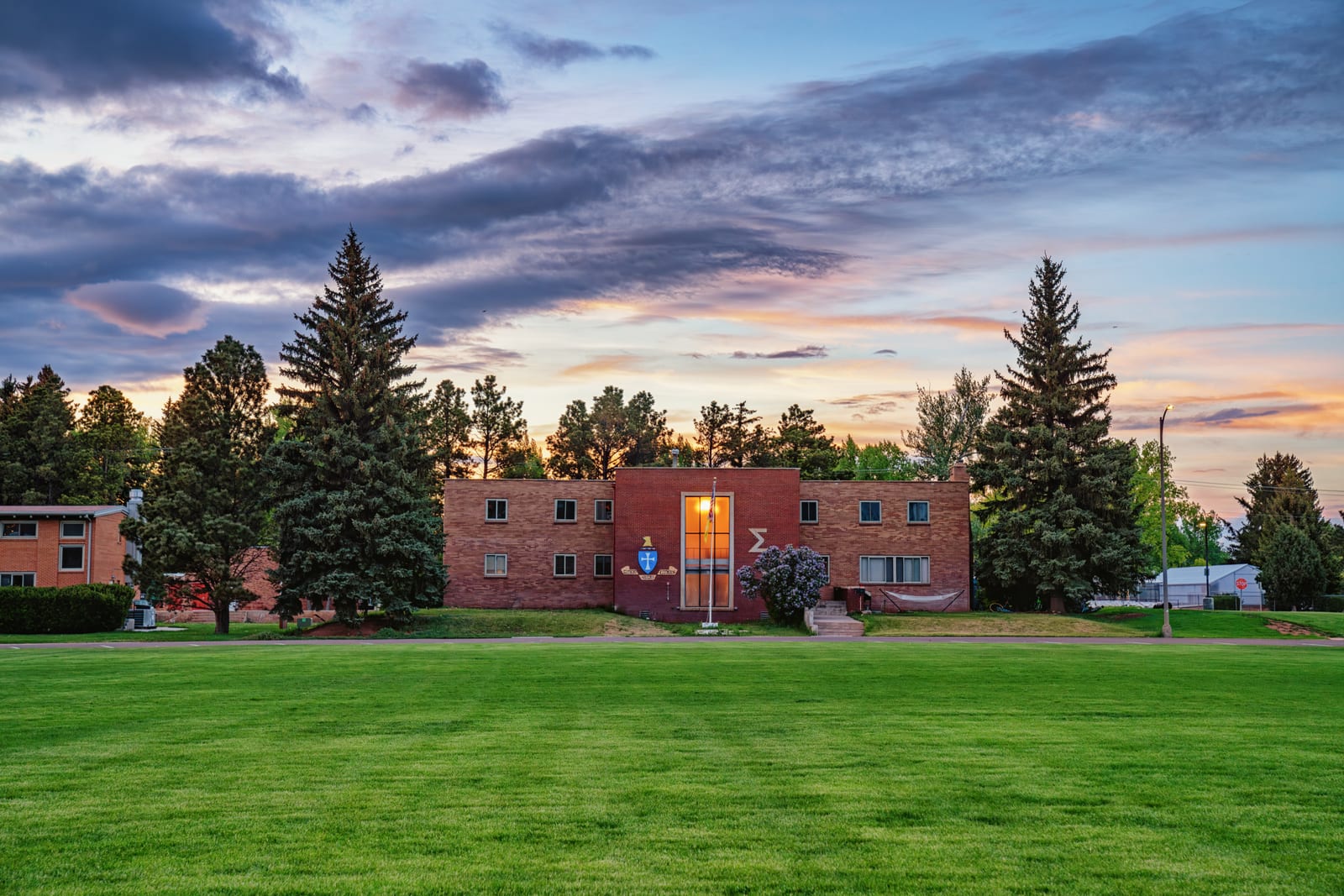
The Sigma Chi Fraternity at 1629 Fraternity Row at the University of Wyoming campus in Laramie, Wyoming, with Fraternity Row Park in the foreground. Verified
The Sigma Chi Fraternity at 1629 Fraternity Row at the University of Wyoming campus in Laramie, Wyoming, with Fraternity Row Park in the foreground. · Photo: Tony WebsterCC BY 2.0
Applies everywhere on the site, on this device — change it any time.
Not set — every fee below is the international rate. Home and EU/EEA rates are often far lower.

courses

22 courses

B.S. · Computer Science

International tuition

US$11,235 per term

Verified

2026/27 · Same rate across the institution · International students

UW charges block tuition: this one rate covers 12–18 credit hours in a semester, so two semesters come to USD 22,470 for a normal full-time year. It is the non-resident rate, which UW applies to international students and to out-of-state Americans alike — its own cost-of-attendance page says "a student who is not a resident of the state of Wyoming will be considered a non-resident or international student", so there is no separate, higher international rate. Mandatory fees and special course fees are set separately by the Trustees and are excluded from this figure. Students taking fewer or more credits than the block are charged per credit ($749 per credit for undergraduate non-residents, main campus).

Show the fee on the university's site
Intake
August (Fall), January (Spring), May (Summer)
Source
Application deadline
Recommended: 1 June for Fall, 1 November for Spring, 1 April for Summer. UW keeps accepting applications after these dates but warns that visa processing may not finish in time.
Source

What you'll study

Not yet added.

Entry requirementsEnglish · grades

English language

  • TOEFL, 71 overall
  • IELTS, 6 overall
  • Duolingo, 100 overall
  • iTEP, 4 overall
Source

Academic offer

Minimum GPA 2.5 for first-year applicants on the International Direct track (2.0 for transfer applicants). Applicants below these English scores are placed on UW's Academic Accelerator or Extended Accelerator tracks instead, which accept a 2.0 GPA.
Source
Convert your grade to compare →

B.S. · Electrical & Electronic Engineering

International tuition

US$11,235 per term

Verified

2026/27 · Same rate across the institution · International students

UW charges block tuition: this one rate covers 12–18 credit hours in a semester, so two semesters come to USD 22,470 for a normal full-time year. It is the non-resident rate, which UW applies to international students and to out-of-state Americans alike — its own cost-of-attendance page says "a student who is not a resident of the state of Wyoming will be considered a non-resident or international student", so there is no separate, higher international rate. Mandatory fees and special course fees are set separately by the Trustees and are excluded from this figure. Students taking fewer or more credits than the block are charged per credit ($749 per credit for undergraduate non-residents, main campus).

Show the fee on the university's site
Intake
August (Fall), January (Spring), May (Summer)
Source
Application deadline
Recommended: 1 June for Fall, 1 November for Spring, 1 April for Summer. UW keeps accepting applications after these dates but warns that visa processing may not finish in time.
Source

What you'll study

Not yet added.

Entry requirementsEnglish · grades

English language

  • TOEFL, 71 overall
  • IELTS, 6 overall
  • Duolingo, 100 overall
  • iTEP, 4 overall
Source

Academic offer

Minimum GPA 2.5 for first-year applicants on the International Direct track (2.0 for transfer applicants). Applicants below these English scores are placed on UW's Academic Accelerator or Extended Accelerator tracks instead, which accept a 2.0 GPA.
Source
Convert your grade to compare →

Mathematics, B.S.

B.S. · Mathematics

International tuition

US$11,235 per term

Verified

2026/27 · Same rate across the institution · International students

UW charges block tuition: this one rate covers 12–18 credit hours in a semester, so two semesters come to USD 22,470 for a normal full-time year. It is the non-resident rate, which UW applies to international students and to out-of-state Americans alike — its own cost-of-attendance page says "a student who is not a resident of the state of Wyoming will be considered a non-resident or international student", so there is no separate, higher international rate. Mandatory fees and special course fees are set separately by the Trustees and are excluded from this figure. Students taking fewer or more credits than the block are charged per credit ($749 per credit for undergraduate non-residents, main campus).

Show the fee on the university's site
Intake
August (Fall), January (Spring), May (Summer)
Source
Application deadline
Recommended: 1 June for Fall, 1 November for Spring, 1 April for Summer. UW keeps accepting applications after these dates but warns that visa processing may not finish in time.
Source

What you'll study

Not yet added.

Entry requirementsEnglish · grades

English language

  • TOEFL, 71 overall
  • IELTS, 6 overall
  • Duolingo, 100 overall
  • iTEP, 4 overall
Source

Academic offer

Minimum GPA 2.5 for first-year applicants on the International Direct track (2.0 for transfer applicants). Applicants below these English scores are placed on UW's Academic Accelerator or Extended Accelerator tracks instead, which accept a 2.0 GPA.
Source
Convert your grade to compare →

Statistics, B.S.

B.S. · Statistics

International tuition

US$11,235 per term

Verified

2026/27 · Same rate across the institution · International students

UW charges block tuition: this one rate covers 12–18 credit hours in a semester, so two semesters come to USD 22,470 for a normal full-time year. It is the non-resident rate, which UW applies to international students and to out-of-state Americans alike — its own cost-of-attendance page says "a student who is not a resident of the state of Wyoming will be considered a non-resident or international student", so there is no separate, higher international rate. Mandatory fees and special course fees are set separately by the Trustees and are excluded from this figure. Students taking fewer or more credits than the block are charged per credit ($749 per credit for undergraduate non-residents, main campus).

Show the fee on the university's site
Intake
August (Fall), January (Spring), May (Summer)
Source
Application deadline
Recommended: 1 June for Fall, 1 November for Spring, 1 April for Summer. UW keeps accepting applications after these dates but warns that visa processing may not finish in time.
Source

What you'll study

Not yet added.

Entry requirementsEnglish · grades

English language

  • TOEFL, 71 overall
  • IELTS, 6 overall
  • Duolingo, 100 overall
  • iTEP, 4 overall
Source

Academic offer

Minimum GPA 2.5 for first-year applicants on the International Direct track (2.0 for transfer applicants). Applicants below these English scores are placed on UW's Academic Accelerator or Extended Accelerator tracks instead, which accept a 2.0 GPA.
Source
Convert your grade to compare →

Physics, B.S.

B.S. · Physics

International tuition

US$11,235 per term

Verified

2026/27 · Same rate across the institution · International students

UW charges block tuition: this one rate covers 12–18 credit hours in a semester, so two semesters come to USD 22,470 for a normal full-time year. It is the non-resident rate, which UW applies to international students and to out-of-state Americans alike — its own cost-of-attendance page says "a student who is not a resident of the state of Wyoming will be considered a non-resident or international student", so there is no separate, higher international rate. Mandatory fees and special course fees are set separately by the Trustees and are excluded from this figure. Students taking fewer or more credits than the block are charged per credit ($749 per credit for undergraduate non-residents, main campus).

Show the fee on the university's site
Intake
August (Fall), January (Spring), May (Summer)
Source
Application deadline
Recommended: 1 June for Fall, 1 November for Spring, 1 April for Summer. UW keeps accepting applications after these dates but warns that visa processing may not finish in time.
Source

What you'll study

Not yet added.

Entry requirementsEnglish · grades

English language

  • TOEFL, 71 overall
  • IELTS, 6 overall
  • Duolingo, 100 overall
  • iTEP, 4 overall
Source

Academic offer

Minimum GPA 2.5 for first-year applicants on the International Direct track (2.0 for transfer applicants). Applicants below these English scores are placed on UW's Academic Accelerator or Extended Accelerator tracks instead, which accept a 2.0 GPA.
Source
Convert your grade to compare →

Chemistry, B.S.

B.S. · Chemistry

International tuition

US$11,235 per term

Verified

2026/27 · Same rate across the institution · International students

UW charges block tuition: this one rate covers 12–18 credit hours in a semester, so two semesters come to USD 22,470 for a normal full-time year. It is the non-resident rate, which UW applies to international students and to out-of-state Americans alike — its own cost-of-attendance page says "a student who is not a resident of the state of Wyoming will be considered a non-resident or international student", so there is no separate, higher international rate. Mandatory fees and special course fees are set separately by the Trustees and are excluded from this figure. Students taking fewer or more credits than the block are charged per credit ($749 per credit for undergraduate non-residents, main campus).

Show the fee on the university's site
Intake
August (Fall), January (Spring), May (Summer)
Source
Application deadline
Recommended: 1 June for Fall, 1 November for Spring, 1 April for Summer. UW keeps accepting applications after these dates but warns that visa processing may not finish in time.
Source

What you'll study

Not yet added.

Entry requirementsEnglish · grades

English language

  • TOEFL, 71 overall
  • IELTS, 6 overall
  • Duolingo, 100 overall
  • iTEP, 4 overall
Source

Academic offer

Minimum GPA 2.5 for first-year applicants on the International Direct track (2.0 for transfer applicants). Applicants below these English scores are placed on UW's Academic Accelerator or Extended Accelerator tracks instead, which accept a 2.0 GPA.
Source
Convert your grade to compare →

How UW compares

Against the other universities in the United States on StudyPath, using each one's verified international fees and its own published housing prices. Universities are only compared with others charging in the same currency (and, for housing, for the same period), so no figure here has been converted. A ~ marks a year worked out from a per-term or whole-course fee.

UW's lowest undergraduate fee for international students is ~US$22,470 a year, for Accounting, B.S.B.. Of the 89 other universities in the United States we list with undergraduate fees in USD, 80 charge more at their lowest, 9 charge less. Their lowest undergraduate fees run from ~US$2,440 (UoPeople) to US$75,960 (UChicago).

Student housing. UW's own lowest published rate is US$3,015 per semester. Of the 32 other universities in the United States we list that publish housing per semester in USD, 30 charge more, 2 charge less. Their lowest published rates run from US$1,727.50 (BYU) to US$8,282 (CU Boulder).

By subject
SubjectLowest fee hereAgainst other universities in the United StatesTheir lowest fees
Computer Scienceundergraduate~US$22,470Computer Science, B.S.78 of 86 charge more~US$12,921 to US$75,960
Electrical & Electronic Engineeringundergraduate~US$22,470Electrical Engineering, B.S.73 of 81 charge more~US$12,921 to US$75,384
Mechanical Engineeringundergraduate~US$22,470Mechanical Engineering, B.S.70 of 77 charge more~US$12,921 to US$75,384
Biology & Life Sciencesundergraduate~US$22,470Botany, B.S.60 of 66 charge more~US$12,921 to US$75,960
Physicsundergraduate~US$22,470Atmospheric Science, B.S.59 of 65 charge more~US$12,921 to US$75,960
Chemistryundergraduate~US$22,470Chemistry, B.S.52 of 60 charge more~US$12,921 to US$75,960

Subjects taught at UW

Each one opens every course in that subject, at every university we hold, with the same verified fees.

Where these figures come from

3 sentences from UW's own site each back several figures above. Each is quoted once here; every course that uses one still opens it and links to its own source page.

  1. Used for application deadline on 22 courses, start dates on 22 courses

    “Recommended Application Deadlines by Semester Fall: June 1 | Spring: Nov. 1 | Summer: April 1”
    Undergraduate International Students | University of Wyoming Admissionsuwyo.eduread 16 Aug 2026
    Open the official page ↗
  2. Used for entry requirements on 22 courses

    “International Direct 2.5 2.0 TOEFL 71 IELTS 6.0 Duolingo 100 iTEP 4.0”
    Undergraduate Admissions | Wyoming Internationalinternational.uwyo.eduread 16 Aug 2026
    Open the official page ↗
  3. Used for international fee on 22 courses

    “Undergraduate non-resident students block rate = $11,235 per semester”
    Tuition and Fees — Academic Year 2026/2027 (FY27) | University of Wyominguwyo.eduread 16 Aug 2026
    Open the official page ↗

More about UW

About & contact

Laramie, United States· view on Google Maps ↗uwyo.edu ↗

Find nearby

These open a map search near Laramie. StudyPath isn't listing or vouching for specific places — what the university itself publishes about on-campus facilities appears under On-campus amenities, cited like everything else here.

No admissions email, phone number, or address verified for this university yet. Not yet collected, not necessarily unavailable.

Accommodation

US$3,015–US$4,900per semester

on-campus residence hall room, 2026-2027 academic year, across room types and halls (McIntyre Hall, Tobin House, North & South Halls, Upperclassman Hall at Orr)

Published by the university itself, not a live listings price. Actual cost depends on room type, availability and when you apply.

Show the source
✓ Word for wordRead 17 Aug 2026
“Room Type Cost (per semester) McIntyre Hall Tobin House North & South Halls Upperclassman Hall at Orr Double $3,015 X X Double New $3,225 X Triple $3,015 X Single Suite $4,685 X X X Double/Private Bath Suite $4,575 X Double/Private Bath Suite New $4,725 X Double/Shared Bath Suite New $4,625 X Single $4,405 X X $3,225 Single New $4,500 X Double as a Single $4,514 X X $3,225 Double as a Single New $4,900 X”
Rates | Housing and Dining, University of Wyominguwyo.edu
Open the official page ↗

Search student housing near Laramie → (partner link)

After you graduate

Rules read 17 Aug 2026. Check the current rules, this may be out of date

What United States's own immigration authority currently publishes. Not a ranking, not a guarantee, and not the same as what any agent or forum will tell you. Whether someone actually obtains residence depends on occupation, points, funds and policy that can change between application and graduation.

Work during study

F-1 students may work on campus without separate USCIS authorization: up to 20 hours per week while school is in session, and full-time during official school breaks and the annual vacation, at a qualifying on-campus job (or an off-campus job that is educationally affiliated with the school, e.g. contractually funded postgraduate research) that does not displace a US citizen or lawful permanent resident. Off-campus employment based on economic need is not available by default — it requires case-by-case USCIS approval (a separate Form I-765 Employment Authorization Document application), granted only after a full academic year in status and only on a showing of severe economic hardship from unforeseen circumstances (or a DHS-declared 'emergent circumstances' event), and is capped at 20 hours/week in session, full-time out of session. Curricular Practical Training (CPT) and pre/post-completion Optional Practical Training (OPT) are separate, study-related practical-training work authorizations governed by their own rules (OPT is covered under 'post-study work' in this entry).

Show the source
✓ Word for wordRead 17 Aug 2026
“May work up to 20 hours per week while school is in session (full-time during those periods when school is not in session or during the annual vacation)”
Employment | ICEice.gov
Open the official page ↗

Post-study work visa

Optional Practical Training (OPT), including the 24-month STEM OPT extension . Up to 3 years
Any F-1 graduate, in any field, may apply for up to 12 months of post-completion Optional Practical Training (temporary employment directly related to their major, authorized via an Employment Authorization Document from USCIS; any pre-completion OPT already used is deducted from this 12 months). A graduate whose degree appears on DHS's STEM Designated Degree Program List (defined by Classification of Instructional Programs codes covering engineering, biological sciences, mathematics, physical sciences and related fields — not every STEM-sounding degree necessarily qualifies) may then apply for a further 24-month STEM OPT extension, for a combined maximum of 36 months, provided the employer is enrolled in and stays in good standing with E-Verify, signs a formal Form I-983 training plan, and the graduate works at least 20 hours per week for that employer. A second 24-month STEM OPT extension can become available if the graduate later earns another qualifying STEM degree at a higher educational level. Allowed unemployment while on OPT is capped at 90 days on the initial 12 months and a further 60 days (150 total) if a STEM extension is granted. Separately and importantly: a DHS final rule taking effect 15 September 2026 replaces the prior open-ended 'duration of status' framework with a fixed admission period (based on the program's length, capped at 4 years) — an F-1 student who needs to remain for post-completion OPT or a STEM OPT extension beyond that fixed period must separately file and be approved for a USCIS Extension of Stay (Form I-539) or the OPT/STEM OPT authorization cannot lawfully be used to remain in the country.

Show the source
✓ Word for wordRead 17 Aug 2026
“The STEM OPT extension is a 24-month period of temporary training that directly relates to an F-1 student's program of study in an approved STEM field. On May 10, 2016, this extension effectively replaced the previous 17-month STEM OPT extension. Eligible F-1 students with STEM degrees who finish their program of study and participate in an initial period of regular post-completion OPT (often for 12 months) have the option to apply for a STEM OPT extension.”
STEM OPT Extension Overview | Study in the Statesstudyinthestates.dhs.gov
Open the official page ↗

Route to permanent residence

OPT and the STEM OPT extension are temporary work authorizations tied to F-1 student status — neither one converts automatically into any form of permanent residence. The realistic route runs through employer sponsorship: an employer petitions for a temporary H-1B specialty-occupation worker visa (initial period up to 3 years, extendable to 6, generally requiring at least a US bachelor's degree or equivalent in a field directly related to the job), which is numerically capped at 65,000 new statuses per fiscal year plus a 20,000 exemption for holders of a US master's degree or higher, and allocated by an electronic registration lottery when demand exceeds the cap — USCIS confirmed the regular cap and the master's-degree cap were both already reached for fiscal year 2027 as of this reading. While on H-1B (or, for a smaller number of people, directly from F-1 in narrower cases such as extraordinary-ability or national-interest-waiver petitions), an employer or the individual can pursue one of five employment-based immigrant-visa (green card) preference categories (EB-1 through EB-5), most of which require the employer to first obtain a Department of Labor labor certification (PERM) showing no sufficient, willing, qualified US worker is available for the role — a process with no fixed timeline. Approximately 140,000 employment-based immigrant visas are available across all categories each fiscal year, and per-country annual limits mean the wait for applicants born in some countries (notably India and China) is materially longer than for others.

Show the source
✓ Word for wordRead 17 Aug 2026
“Some immigrant visa preference categories require you to have a permanent job offer from a U.S. employer. This employer will be considered your sponsor/petitioner and will file an immigrant petition with USCIS on your behalf.”
Permanent Workers | USCISuscis.gov
Open the official page ↗

Route to citizenship

Naturalization is administered by USCIS — the same agency that runs the immigration system, since both sit under the Department of Homeland Security. The most common route requires having held lawful permanent resident (green card) status for at least 5 years (3 years if married to and living with a US citizen for that period), continuous residence in the US for that period, physical presence in the US for at least 30 months of the preceding 5 years, at least 3 months' residence in the state or USCIS district where the applicant applies, good moral character for the qualifying period, basic ability to read, write and speak English, knowledge of US history and civics, and taking the Oath of Allegiance. The Oath itself contains renunciation language — an applicant swears to 'absolutely and entirely renounce and abjure all allegiance and fidelity to any foreign prince, potentate, state, or sovereignty' of which they were previously a subject or citizen — but this is a declaration of allegiance to the United States rather than a mechanism the US enforces against a person's other citizenship: US law does not require a naturalizing citizen to formally give up their original nationality, and the State Department's own guidance states that a person may naturalize in the United States (or abroad) without any requirement to choose between US citizenship and another nationality. Whether the applicant's country of origin lets them keep it in turn is that country's own decision, not a matter of US law.

Show the source
✓ Word for wordRead 17 Aug 2026
“Show you have been a lawfully admitted permanent resident of the United States for at least five years;”
I am a Lawful Permanent Resident of 5 Years | USCISuscis.gov
Open the official page ↗

What the government currently prioritises

The United States has no federal points-based or general shortage-occupation list of the kind Canada, Australia, the UK or New Zealand publish. The closest official equivalent is the Department of Labor's narrow 'Schedule A' designation, published on USCIS's own site, which exempts only two specific groups of occupations from the standard PERM labor-certification process because DOL has already determined there are not enough available US workers for them — it is not a broader skills-shortage list and covers only a handful of roles.

Show the source
✓ Word for wordRead 17 Aug 2026
“Currently, DOL has designated 2 groups of occupations under Schedule A. Group I includes professional nurses and physical therapists. Group II includes beneficiaries with exceptional ability in the sciences or arts (including college and university teachers) and immigrants of exceptional ability in the performing arts.”
Permanent Workers | USCISuscis.gov
Open the official page ↗

Read 17 August 2026, during an unusually volatile stretch of US immigration policy — re-check every figure here before relying on it, more so than for any other country on StudyPath. Three developments in particular are live and could each change what a prospective student should expect: (1) A DHS final rule published 17 July 2026 ends the decades-old 'duration of status' framework for F-1 students effective 15 September 2026, replacing it with a fixed admission period (program length, capped at 4 years) plus a mandatory USCIS Extension of Stay (Form I-539, with biometrics and a fee) for anyone needing to remain for post-completion OPT or the STEM OPT extension beyond that fixed period — a procedural step that did not previously exist for most students. A transition window applies for students already in the US on the effective date. (2) A presidential proclamation effective 21 September 2025 requires a $100,000 payment for most new H-1B petitions filed for a beneficiary outside the US without a valid H-1B visa — the single biggest practical barrier between OPT/STEM OPT and long-term US employment for a new graduate whose employer has not already secured them an H-1B. As of this reading a federal district court had vacated DHS's guidance implementing the payment and a Court of Appeals had denied a government motion to stay that ruling, so DHS states it is complying 'while DHS considers next steps' but 'still plans to collect the payment' if the ruling is overturned — the requirement's real-world status is genuinely unsettled. (3) USCIS had already announced the regular H-1B cap (65,000) and the master's-degree exemption (20,000) were both reached for fiscal year 2027, meaning cap-subject H-1B sponsorship is a lottery with no guarantee of selection even where an employer is willing to sponsor. Only DHS/ICE (via the Student and Exchange Visitor Program), USCIS and studyinthestates.dhs.gov are treated as authoritative here per StudyPath’s rules — never a university international office, an immigration-law firm's explainer, or a visa-consultancy aggregator, all of which publish this same information with varying currency and interest in the outcome. citizenshipRoute added 17 August 2026: the 5-year/N-400 residence requirement and the Oath of Allegiance's literal renunciation clause are both cited to uscis.gov (460266156f73de78 and bd9ee58930f2ed05, the USCIS Policy Manual's own Oath of Allegiance chapter, already archived above for a different purpose and reused here). The practical dual-nationality statement is instead cited to the State Department's own travel.state.gov — a government domain newly accepted as a source here — because USCIS's own naturalization pages state the Oath's renunciation wording without separately confirming that the US does not enforce it, while travel.state.gov's 'Dual Nationality' page states the practical policy directly ('U.S. law does not require a U.S. citizen to choose between U.S. citizenship and another (foreign) nationality'). travel.state.gov returned HTTP 403 to automated fetching; it was archived from a browser capture. naturalisationStatus set to 'published-route' on 18 August 2026: the authority already cited under citizenshipRoute publishes criteria a foreign resident could actually follow, which is the only claim this field makes. It is deliberately not a judgement about how attainable that route is in practice. studentVisaFunds deliberately left empty, 19 August 2026, after checking: the United States publishes no national proof-of-funds figure for the F-1/M-1 student visa, so there is nothing to record. SEVP’s own Study in the States page on Financial Ability (the page itself last updated May 25, 2023) states the rule without any amount: a prospective student must show that they or a sponsor have “sufficient funds to cover tuition and living expenses during the period of intended study”, and it is the designated school official (DSO) at the SEVP-certified school who collects that evidence before issuing the Form I-20. The threshold is therefore set per school and per programme on the I-20 itself, and acceptable forms of evidence vary by school too. Any single dollar figure presented as “the US requirement” would be invented. A future collector should not go looking again unless DHS or the State Department starts publishing one.

Open the immigration authority's own page ↗

Student photos

Contributed by students and applicants. Not checked the way the campus photos above are, just real photos from people who've actually been here.

Loading…

What students say about UW

Opinions from students and applicants. Not checked against the university's own pages the way the fees and deadlines above are.

to write a review. Signing in with your university email marks you as a verified student here.

Loading reviews…